Tuesday, May 22, 2007

1200 Days on Mars


There was exciting news from NASA yesterday as the Spirit Mars rover has accidentally discovered silica-rich soil, a mineral that likely could not have formed without the presence of water. It's a strong further clue that Mars was once warmer and wetter than it is today, and might (or might once have) supported some form of life.

Which is pretty cool stuff, but it isn't really what this post is about. What struck me was a quote from Steve Squyres of Cornell University, leader of the rover team in a TimesOnline Article. He says, "This is a remarkable discovery. And the fact that we found something this new and different after nearly 1,200 days on Mars makes it even more remarkable. It makes you wonder what else is still out there."

Indeed. We've been poking around the planet we live on for many thousands of years and it continues to surprise and mystify us. Which is why I'm always appalled at detractors who dismiss the idea of a return to the Moon because, "we've already done that."

What surprises me most is that I hear this not just from opponents of space exploration, but from space advocates as well. Many of them simply see the Moon as a nothing more than a distraction from their real goal of a manned expedition to Mars. "Been there, done that, got the tee-shirt and some rocks. Move along. Nothing to see here."

Bull.

Now, admittedly, the Moon is in many ways a far less interesting and complex place than Mars. But we still know so little about it. The assumption that the Apollo missions "saw everything there is to see" is simply absurd, and some people don't appreciate how short a time they were there, and how little they saw while they were there. First, let's look at the numbers:

Apollo 11

Time on Surface: 21 Hours, 36 Minutes
EVA Time (time spent outside the spacecraft actually doing something): 2 Hours, 32 Minutes

Apollo 12
Time: On Surface: 31 Hours, 31 Minutes
EVA Time: 7 hours 45 Minutes

Apollo 14 (Apollo 13, of course, suffered a crippling explosion on the way to the Moon and was unable to land)
Time on Surface: 33 Hours, 30 Minutes
EVA Time: 9 Hours, 22 Minutes


Apollo 15

Time on Surface: 66 Hours, 55 Minutes
EVA Time: 18 Hours, 33 Minutes


Apollo 16

Time on Surface: 71 Hours, 2 Minutes
EVA Time: 20 Hours, 14 Minutes


Apollo 17

Time on Surface: 75 Hours
EVA Time: 22 Hours, 4 Minutes

So that's it, a total of about (by my sometimes shaky math) about 80 and one half hours on the Moon. And a lot of that was spent climbing up and down ladders, opening and closing hatches, stowing and unstowing gear, figuring out how to walk and work (every flight was essentially a training flight). Three days and change. Almost seven man days, if you're generous.

Yeah, that's just the manned part, but it isn't like there's a huge body of unmanned exploration to back it up. The U.S. sent seven unmanned Surveyor landers in advance of the Apollo program. Five of these landed. The others crashed. These were frightfully primitive by current standards, comparing to the Spirit and Opportunity rovers about like a rusty skateboard compares to an SUV. They had a crude TV camera, a few simple instruments, and some had a simple arm that seemed to have been borrowed from a carnival claw-machine.

This is in no way intended to be dismissive of the accomplishments of the talented people who built this thing. It's simply a product of its time, relatively early in the TV era, and the dawn of the computer/microelectronics age. Compare it to then-contemporary dial phones, televisions with vacuum tubes, and room-sized mainframe computers with 8k (no gigs, not megs, kilobytes) of memory.

The Russians later two sent rather more sophisticated landers that included remotely operated rover vehicles. Technical wonders at the time, and a bit more comparable to Spirit and Opportunity, they're still primitive by modern standards.

Even ignoring the total time spent in exploration, keep in mind that in all cases, the landing sites were picked for safety first, and their scientific interest second. This is especially true of the early Apollo missions. And in any case, that's a handful of sites on a globe with about the same surface area as the United States, Russia and Canada combined. And the sites chosen aren't even a random sampling. Even ignoring the safety issue, none of the sites were on the lunar far-side, which has a surface completely (and perhaps a little mysteriously) different than the one we see in our sky every night. None of the landings took place near the poles, where frozen water may still exist.

What do we know about the Moon? How much have explored? Slightly more than none and zilch. We have barely been there. We have not done that. We don't even know where tee-shirts are sold. But we did get some rocks representative of fairly safe landing zones.

Okay, again, this has to be taken in perspective. The Apollo program was a monumental accomplishment, a wonder if its age or any other. But it ended too soon, and it should have been only the beginning.

I realize too that, although what I'm advocating is a manned return to the Moon, this could just as easily be used as an argument for unmanned exploration, something I'm certainly not against. Quite the contrary, I think any manned return to the Moon should happen in conjunction with a strong program of unmanned exploration. In fact, the Moon could be an ideal laboratory to study how to dovetail the use of man and machine in exploration of another world, lessons that could be invaluable in planning the much longer, dangerous, and yes, more expensive trip to Mars.

Yes, I think we should go to Mars, with robots, and eventually, with human explorers. But one thing I'm not sure the Mars advocates have considered is, "what next?" Going to Mars is going to be hugely expensive and dangerous, and while it is certainly worth doing, it seems doubtful that it will in any reasonable term become routine. In fact, it's possible it could be a one-shot deal. At most, it seems likely that a Mars program would consider of no more than a hand-full of manned expeditions before costs became prohibited.

Yes, there will still be much of Mars to explore, but does that matter if we can't afford to explore it? And as we have seen with the Moon, the presence of unexplored territory is no certainty that we will follow through once the novelty wears off. What if we "go there, do that?" Even if cost were no object, other than asteroids there are few obtainable targets for manned exploration in the solar system without great leaps in propulsion technology.

A stepping-stone approach to Mars via the Moon would allow us to establish a more permanent off-world foothold, one that might better prepare us for that great leap, and allow us to more affordably continue our off-world explorations afterwards. The Moon is not a distraction from Mars. It is both a testing and training ground for further off-world exploration, and a sustainable foothold off this fragile world of ours. A long-term manned presence on the Moon greatly increases the possibility that we will not only successfully go to Mars once, but that we will one day return again and again, perhaps eventually to stay, perhaps to map and explore all those, far, undiscovered lands.

And I wonder what unexpected secrets we will find, on our 1200th day on the Moon? Only 1196 and 2/3rds to go.

(All photos NASA/JPL)

Monday, April 30, 2007

Minions at Work video trailer


According to some on-line discussions I've been following, it seems to be the hot thing for authors (or publishers, or publicists) to create video trailers for their books and place them on the web. Here's one from my old-pal Virgina Baker, here's an author-produced on from P.R. Frost and here's one for a mystery anthology featuring my friend Kris Rusch. Here's a fancier professionally produced version for science fiction writer Greg Bear's novel Eon.

When publishers do these they're great, but apparently, some authors are spending many thousands of dollars out of their own pockets to have these things produced for them. What do I think of this? Well, like most extreme self-publicity efforts, I think it's usually at best futile, at worst, counter-productive.

My theory of author publicity is still that it should be free and take none of the author's time. Money should flow into an author's pockets, not the other way, and publicity time shouldn't cut into a writer's writing time. (Which means "no-time" makes it okay to post on a blog, if it's something you enjoy enough to consider recreation.)

Which is why I think author produced video trailers can be just fine. The tools to make them are pretty much free (both Macs and PCs have free video editing software that will do the job), and most of the materials for a basic trailer are generally already at hand (cover shots, cover art, cover copy, pull-quotes, author photos, etc.) Yes, you could get original music, professional voice talent, original art, fancy animation. Yes, you could actually hire actors and dramatize scenes from the book. But to my mind, that's the sort of stuff a publisher should do, only if they see it as being cost-effective. Authors should keep it simple. I believe that you can get most of the bang for very few of the bucks.

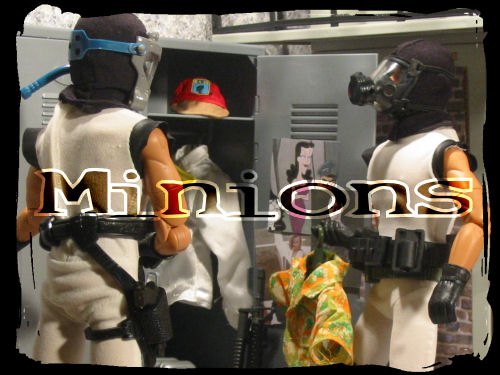
Given all this, I decided to put my toes in the water. Lacking a new release to promote, I instead did a video trailer for my weekly web comic, Minions at Work. To view the trailer directly in the blog, click on the linked image in the sidebar to your left.

This was produced using all free software. Video editing and effects were done using Microsoft Movie Maker. It's simple, but easy to use and it does the job. I did my own music (yeah, most people will NOT go this route) using a freeware Midi sequencer called Anvil Studio. Finally, I used an nifty open-source sound recorder/mixer/editor called Audacity (also available for Mac and Unix/Linux) to save my music as a MP3 file that Movie Maker could understand and to so some mixing and editing. (This is also a good tool for creating your own voice or narration tracks.)

So, we have tools - free, source material: all stuff existing on my hard disk, time - a few hours of (for me) fun-time. It could be slicker. It could be better. But it isn't bad, and when I do get around to doing a trailer for a book, it will be far better yet...

Tuesday, April 17, 2007

Silent Running Trailer

Doubtless the copyright police will find this sooner or later, but for the moment, here's the link to the Silent Running trailer that I discovered on YouTube. If you've never seen the film, keep in mind that that the trailer doesn't represent the movie very well. It tells too much, too little, and misrepresents the film at several points, but it does have some nifty clips from the film in it that will give you some sense of its unique look. Domes and drones. Gotta love it. Go check it out while you still can.

Tuesday, April 10, 2007

Why I love "Silent Running" (and you should too)


There are movies you want to forget, movies that entertain purely in the moment and wash from your consciousness five minutes after you leave the theater, and then there are movies that keep creeping back into your consciousness years or decades later, demanding to be watched again to see if they've stood up to the sands of time.

For me, "Silent Running" is one of the latter category of films. I've watched it many times over the years, though not recently, but several months ago it came up in an on-line discussion, and I was compelled to rent the DVD from Netflix and watch it again.

Now, this is always a task approached with trepidation, because some films simply don't hold up, even films you've watched repeatedly and enjoyed. Eventually you, or the world you live in, simply passes them by. At best they become watchable as a relic of their time or an object of nostalgia. On surface, Silent Running seems particularly vulnerable to this, with its Joan Baez songs, cult actor Bruce Dern as star, and its vaguely counter-culture themes.

But I was pleased to find that not only did the film hold up, it's actually aging well. Yes, the once-thrilling special effects have gone from spectacular to merely serviceable for the most part, but there's never a point where they become embarrassing. The spaceship interior sets still look great, and for the most part would look right at home in any modern science fiction film or TV show. And the drones, Huey, Dewey, and Louie, are still among the best cinematic robots (and most endearing non-human characters) of all time.

The enjoyable soundtrack (by Peter Scheckele, better known as his alter-ego P.D.Q. Bach) gives the sometimes claustrophobic film grandeur and scope, and the songs, which at the time seemed to me a bit intrusive, now seem organic and essential to the film.

Moreover, the writing, direction, and performances (much of the movie is essentially a one-man-show, with Bruce Dern ably carrying the movie with only the drones and his artificial environment to play against).

But not only did the movie hold up, as I watched it, I became increasingly convinced that it was not merely a good movie, it was an important movie, a cinematic milestone that almost single handedly created the modern space science fiction film.

Without Silent Running there is no Star Wars, no Close Encounters of the Third Kind, no Star Trek films (or follow-on TV series), no Babylon 5 or Farscape or reimagined Galactica. In so many areas, from the most technical to the most artistic, Silent Running either radically changed or reinvented the genre in dozens of important ways.

Silent Running
should be recognized as one of the ground-breaking sf films of all time, on a list with Forbidden Planet, The Day the Earth Stood Still, 2001, Alien, Bladerunner, and a handful of other better-known films. But for the most part, it seems to languish in obscurity, existing in the shadow of Star Wars, a film that in many ways is made in its image, and in at least a few ways is probably inferior.

Why? Well, Silent Running wasn't a huge commercial success a the time. It was produced as part of an experimental program by Universal to produce five films on a budget of a million dollars (which sounds absurdly low-budget now, and was still pretty low even then) each (ironically, one of these five was George Lucas' break-out hit, American Graffiti). But also as part of the experiment, it was shoved into theaters with no real publicity campaign. Like many people, I think I first became aware of the film not from its initial release, but from seeing the soundtrack album (with its spectacular art from the poster seen above) in a record store. Likely, I first saw the movie on TV, though I later saw it in art-house and college film-class screenings.

People who have seen Silent Running usually remember it, but frankly, not that many people have seen it. The current DVD release lists for about $15, is packed with extras (several documentaries including a 45-minute "making of," and a commentary track by director Doug Trumbull and Bruce Dern) and is well worth seeking out.

So enough about it being good. Here are some of the reasons I think it's important...

1.The entire "Star Wars" era of special effects begins here.


Now, admittedly, Doug Trumbull cut his teeth on the ground-breaking effects of 2001, a Space Odyssey, but in many ways, that film would have a dead end without this film. Director Stanley Kubrick was notoriously secretive about some aspects of the effects, to the extent of destroying the models and most records of their creation after the film was finished. This may have had more to do with preventing a sequel than any real attempt to hide his methods, but while many "big iron" effects for the film (like the rotating Discovery centrifuge set) were well publicized and documented, the model work was relatively undocumented.

In addition, 2001 did little but verify the conventional wisdom of Hollywood: that good special effects could only be done in a huge-budget studio blockbuster. The idea that first rate effects could be done cheaply, and might even make the movie cheaper, that just was unimaginable.

So along comes Silent Running, done on a modest budget, which still managed to incorporate some of the most spectacular models and effects seen on screen until that time. It established the hyper-detailed "kitbashing" (using plastic model parts and other shapes to provide surface texture on spaceships) look that would soon be followed by Star Wars and countless other movies and TV series.


One of the people working under Trumbull on the effects was John Dykstra, who managed most of the model photography for the movie. Dykstra was the wizard who developed the computerized motion-control camera system that made possible the elaborate space-battles of the pre-CGI Star Wars movies (and pretty much every other effects film to follow). Though there is no motion-control on Silent Running, the long-exposure photography methods used on the models were similar, and there were then state-of-the-art robots on set. It isn't difficult to imagine Dykstra already putting the pieces together in his mind.

2. Silent Running brought industrial thinking into film-making

Prior to Silent Running, not only special effects, but many aspects of movie production, had long been static. Sets, props, and models were "old school," done with wood, plaster, fabric and more rarely, metal. Most physical aspects of the film, lights, photography, construction, used long-established methods, many of them rooted in the theater.

Silent Running seemed to take a fresh-look at almost everything. Trumbull came from an engineering background, and he brought new technologies, materials, and production methods into the film. Sets and props were produced using modern plastic molding techniques. Rather than simply using wooden props, many items on the Silent Running set were in some way functional: the small ATV vehicles driven around the ship, robotic arms, video monitors, electronic instrumentation, it didn't just sort of look right, it worked. It contributed to a feeling a realism and believability that holds up pretty well even today.

More importantly, though Star Wars had a larger budget, it simply couldn't have been done without the methods established by Silent Running. You see this all through the film in thousands of places, but it's most obvious in the stormtrooper armor. In old-school Hollywood, it would have required more than film's entire budget to individually produce each suit by hand. The use of plastics allowed them to be mass-produced affordably. The same goes for many of the droids, vehicles, and even Darth Vader himself.

3. Silent Running established the "grunge" look for science fiction films

Before Silent Running, the look for most science fiction spacecraft was clean, mechanical, and sterile. The Valley Forge was one-part well-used industrial and one part lived in. The floors were dirty. People decorated their living spaces, they played pool and poker to kill the boredom. Things showed wear-and-tear. People personalized their uniforms. The Valley Forge was a place where people lived and worked, and it showed it.

Star Wars took it a step farther, by creating even more grungy places (trash-masher, anyone?) and showing us whole, living, cities and worlds, but it starts with Silent Running, and you can trace the line on to the Alien movies and even Bladerunner.

4. Silent Running brought fully-realized characters into science fiction film

Before Silent Running, most future science fiction charters fell into the categories of a handful of stereotypes. There was the square-jawed hero/military man. There was the idealistic and detached (possibly even mad) scientist. There was the cold-blooded human robot. There was the lovely but helpless heroine. There was the slightly dim comic relief. The godly and arrogant (possibly with justification, probably not) alien. A few others.

Even superior films like 2001 and Forbidden Planet usually drew their characters from that pool (and to a lesser extent, so did the Star Wars films that followed).

But the hero of Silent Running wasn't all good, and it's villains weren't really bad. All of them had reasons for acting as they did, flaws, and a whole range of human quirks. Bruce Dern clearly gets a great deal of credit for bringing his character to life, and for picking a number of his Actor's Studio pals to fill out the rest of the Valley Forge crew. These characters wouldn't have been out of place on a contemporary commercial fishing boat, or an oil-platform, or a coal mine, and that was exactly the point. Silent Running brought to cinema the idea that while technology and circumstances may move on, people will remain very much the same. It suggested that science fiction could tell human, character-driven stories, and not just intellectual treatments of ideas, or scary tails of monsters, or square-jawed adventures.

The crew of the Valley Forge is the clear model for the crew of Alien's Nostromo, or the space marines that followed them in Aliens, or the space-cowboys of Serenity.

5. Its environmental themes are more timely than ever

Unfortunately, the idea that ecosystems might collapse, that forests would all be destroyed, and especially that most people would just sit around and let it happen, that all seems way more credible to me now than it did in 1972. Yes, from a strictly science-fictional standpoint, this works best taken as an eco-fable. (What do the people on this plant-deprived Earth eat, or even breath for that matter?) But it's way less over-the-top that I originally thought. (Actually, a whole range of 70s cautionary sf films, Soylent Green, the Omega Man, even Planet of the Apes, seems less fantastic than they once did, which is a pretty sad commentary on the state of modern life, actually.)

6. Best robots ever!

Okay, this is a stretch, especially as fond as I am of Robby the Robot, but Huey, Dewey and Louie broke all manner of ground for cinematic robots. With the exception of Robby, most movie robots to this point had been soulless monsters, just waiting (and often not very long) to run amok. Even Robby, as benign as he is, remains a frightening and potent symbol of technology beyond our understanding.

The drones were believably tools, simply serving as they were programmed to serve. Yet as sophisticated as they obviously are, they also have developed human-like quirks and surprising behaviors. It's hard not to think of them as innocent children caught in some tragedy beyond their understanding. Perhaps this is actually their nature, or perhaps it is merely something we as humans, trying to understand them, project on their boldly un-anthropomorphic shapes and methods of moving and communicating. Either way, it says as much as us as it does about them.

Many scenes with the drones remain the most moving and memorable in the movie. Trumbull's genius was in making them both the least anthropomorphic of film robots, and the most human. The drones were played by human actors, double-amputees, walking on their hands, and hidden inside clever, light-weight, plastic suits, allowing them to deliver a convincing performance without needing to resort to mechanical contrivances to hide their humanity. And of course, Bruce Dern's performance in playing to them also deserves some credit for the power their scenes carry.

And while some aspects of the on-screen methods used to program the drones haven't held up well (keying card-game rules by hand into a terminal or resoldering circuits under a microscope, all guided by a mimeographed service manual), overall their appearance and behaviors have only become more realistic as robots have advanced. I suspect that it's only a matter of time before some robotic scientist, influenced by the film at an early age, builds a functional drone modeled on the early version.

Even if George Lucas hadn't admitted the influence, it should be obvious that without the drones, there is no R2D2 as we know him. And while R2D2 is a pretty cool film robot, in most every measure besides public recognition, the drones just have him beat.


There are other points to be made, but I think the defense can rest here. Without Silent Running, it's doubtful that any of the modern classics of science fiction film and television would exist, or at least, if they'd exist in anything like the form we know them today. It's a landmark, ground-breaking film which had untold influence on the industry.

It's interesting to note too that all the film's influence can't be credited entirely to the film itself. While much of the production of 2001 went unseen, every aspect of Silent Running was unusually well documented. Not only was it the subject of a detailed 45 minute "making of" documentary (yes, the one on the DVD), but it was covered extensively in the industry press, most notably a massive series of articles in American Cinematographer magazine.

Thanks to this, Silent Running provided both inspiration for a whole generation of film makers hoping to make low-budget science fiction films, and a "how-to" guide to dozens of useful and innovative techniques that could be applied to make them.

It's a shame that Doug Trumbull was as interested in innovating the technology used to produce and display films as he was in the films themselves. As a result, he made only one other major theatrical feature, 1983's Brainstorm, a film better known for the death during production of star Natalie Wood than any virtue of the film itself.

Instead of making films, Trumbull became obsessed with a series of largely dead-end large-format projection systems that he hoped would bring greater realism and audience involvement to the masses. Some of these later did find some application in motion-ride systems, and Trumbull did direct several programs for these attractions.

But while this new technology could have revolutionized cinema, for various reasons it didn't, and now the digital world has largely passed it by. I'd trade it all for even one more film like Silent Running.

Thursday, March 08, 2007

I Hate Destiny


There's a great scene in Mel Brook's classic parody film "Young Frankenstein." The young Doctor Frankenstein, as played by Gene Wilder, has traveled to his grandfather's castle in Transylvania and is gradually uncovering the secrets of his ancestor's experiments in reanimating the dead. Though he has tried to distance himself from his family history, he is strangely, almost mystically, drawn to it. He lays in his bead, and his slumber is interrupted by a fitful dream. "Destiny," he mumbles in his sleep. Then again. "Destiny!" Then he begin to rock from side to side, falling into to cadence of a cheerleader, "no escaping, that's for me! Destiny! Destiny! No escaping, that's for me!"

Even in 1974, Brooks (and Wilder, who wrote the screenplay as well as starred) knew that destiny was tired and cliched concept worthy primarily of parody. Yet it is the cockroach of story tropes. Not only has it refused to die, it seeming has grown in popularity of use, as I was reminded by episodes this week of two popular TV shows I generally like very much, Heroes and Battlestar Galactica. (Spoilers for recent episodes of both shows follow, so if you haven't caught up your TiVo or live outside the U.S. where episodes are delayed, proceed with caution.)

In fiction, the concept of destiny (and the often closely related, often overlapping, trope of prophecy) takes on many forms, but the most common goes something like this. Our protagonist either learns of or comes to believe in some special destiny ahead of them. Often there are cryptic prophecies here (as I said, overlapping), or visions, or dreams, or perhaps an inscription on some ancient tablet or temple wall to point the way. Perhaps the destiny of the coming hero/leader is already known to our protagonist or others around him/her, and they only later beginning to suspect that he/she is The One.

At that point, our hero will either seek their destiny, or fight hopelessly against, it, but either way, they're headed there on rails. There will be much hand-wringing over what they cryptic-to-the-point-of-uselessness prophecy/inscription means, and the mysteries will be dragged out, often to tiresome lengths. Maybe the villain knows about the prophecy too, and tries to put the whack on our protagonist, but that trick never works. Sacrifices may be made along the way, there may be some twists and turns, a surprise or two, and it may not come out exactly the way you imagined, but destiny will be fulfilled because -- hey -- it's destiny!

And really, it's this most basic use of destiny that bugs me. It's certainly possible to write good stories using the concept, and to apply it in different ways, but there's a recursive, meta-element to the story use of destiny. Once a writer starts to apply it to the story, all too often it lazily falls into the above pattern.

I'm not sure where the concept of destiny first crept into literature, but it is certain that it is very, very old. It's used in the Bible, for instance (look at Moses) and it's the basis of Arthurian legend. Perhaps it's as old as literature itself, and quite possibly older.

My suspicion is that it is closely related to the concept of the divine right of kings, the idea that the had of God (or some similar supernatural force) reaches down on high and delivers greatness onto some individual. By this rule, great heroes and leaders aren't made, or even necessarily born. They are created, by powers beyond humanity.

It comes down, I suppose, to the fundamental question of free will. Free will, may be an illusion, but by golly it's a good illusion, and I like it. I like the idea that I have free will, and I like the idea that my heroes (and villains, for that matter) have it as well. I like them to make choices, and then see the consequences of those choices honestly played out in drama.

Destiny cheats all that. Ultimately it doesn't matter what choices the hero make. Ultimately destiny is going to use its big, intrusive hand to shove him back onto his preordained course. In fact, a convention of these stories is often that fighting destiny is bad. Destiny is a bitch, and it will often smite your girfriend, or your dad, or your favorite dog Carl if you don't immediately let her have her way.

Now that I think of it, there's another ancient story convention closely related to destiny, one that that has more completely condemned to the dust-bin of literary history: deus ex machina, "God out of the machine." It originates in the ancient Greek and Roman theater, where an actor playing a God would be lowered out of the rafters on a lift to extricate the hapless human characters from their hopeless situation.

In modern terms, it's any story where the characters are rescued from their situation by any intrusively external and unexpected device rather than by their own actions. It's seen as a cheat, and most writers are taught early on to avoid its use. But thinking about it, how is the typical destiny story anything by deus ex machina writ large? In a destiny story, the Gods don't even wait till the end of the play to hit the down button on their cosmic elevator. In a destiny story, they've the first ones on stage, yanking and shoving the other players around through the whole show.

Let's get back to those TV shows I was talking about. First, and to me most annoyingly, Battlestar Galactica. Okay, I really like this show, and I have to let a certain amount of destiny and prophecy slip by. It's really fundamental to the series itself, which is built on mythic and religious elements (as was, somewhat more ham-handedly, the original series).

So when a Galactica character says something like, "this has all happened before, and it will all happen again," I'm okay with that. It's all part of a larger mythic structure that, usually, isn't the story itself. It's simply a framework within which more human stories are told.

Sure, there are the ancient clues to Earth, and how we find them. But that isn't destiny, that's just the McGuffin of the week. And certain characters have had prophecies applied to them before, especially President Laura Roslin. But it's only really become intrusive in a plot line involving Kara "Starbuck" Thrace which (seemingly) reached its climax last week the the death of the character.

In this case, both prophecy (as delivered by "oracles") and visions (in the form of a pacticular "eye of God" design that Kara has felt compelled to paint and draw since childhood) come into play. We are told again and again, from by several widely dispersed characters, that Kara has a "great destiny." I'll even allow for some of this. Kara made a great flawed and reluctant hero, fighting destiny every step of the way. For a while, I thought she might even escape it. But no...

If this episode is to be taken at face value, her "great destiny" was to die a stupid, pointless, and self-inflicted death. It's been suggested by the show's creator, Ron Moore (who I greatly respect as a writer, even if I don't always agree with his decisions) that her death will ultimately have some greater meaning for the future of the colonists (and perhaps the Cylons as well, since they were even more interested in her "destiny" than the humans were). A suspicious mind might even suspect that while she may have "crossed over," perhaps she isn't as dead as she appears.

But ignoring all this, it was just an annoying story to watch. The prophecy elements had become intrusive and heavy-handed to the point of giving the character no real purpose other than self-destruction, and the resolution required a character defined by her willfulness and Independence, to blissfully surrender to her stupid end.

Hopefully it will all get better, and in the later context of the show, this will seem like no more than a speed-bump. Hopefully.

A much different (and in fact, more diverse) approach to destiny can be found in Heroes, where the concept takes on many form. First and most literally, there is Hiro's conviction that his has a "destiny" to use his powers over time and space to become a hero. Okay, he calls it destiny, but I call it conviction. I call it character. Hiro is trying to become a hero because he has chosen to do so. The powers don't make him a hero. Others on the show have powers, and have much different paths. Hiro has made a choice to follow his current path (wherever it leads him, and I hope it is to success). Free will applies. This is destiny in name only.

But the show also has several forms of prophecy, more or less supernatural. Artist Isaac Mendez has been shown to be able to paint the future (an ability also used on occasion by human-duplicator Peter Petrelli). A more science-fictional version of prophecy derives from Hiro's time-travel abilities. Twice (most recently in this week's episode) he's traveled forward to see the destruction of New York City by some kind of explosion. A future version of Hiro also returned to present day and delivered the cryptic message, "save the cheerleader, save the world."

From a story standpoint, not much of this bothers me. Why? Well, while both the paintings and the time travel episodes forecast the future, it is yet to be determined that they absolutely define it. In fact, it seems likely that they do not, since we can presume (if not with absolute certainty) that the destruction of New York will somehow be averted. I can also allow for the typically cryptic "prophecy" of "save the cheerleader, save the world," as Hiro explains he is trying not to cause a rift in time. Perhaps saying or doing anything too direct would cause a paradox. But it suggests also that, within limitations, Hiro knows that time can be changed.

Again, while the rules of the Heroes universe have yet to be completely defined, there's no suggestion that free will is violated. The characters have some clues as to what will, or could, happen in the future, but they apparently can change that future. Their action, and their choices, have consequences.

So, lets try to boil this down to a set of rules or guidelines for effective use of destiny/prophecy in fiction.

1. Free will must be preserved. Characters must have choices, and those choices must have honest results and consequences within the context of the story.

2. Prophecy should forecast, not predict. This is an important distinction, as one leaves your characters room to shape the future, and the other does not.

Of course, there is an entire category of story based on the idea of changing the future while maintaining the prophecy, "cheating destiny" so to speak. Perhaps our heroine sees a vision of her lover stabbed to death, but changes events so that it is actually the villain disguised as her lover who is killed. Its a small (but important) part of the movie "Back to the Future," where when Doc Brown learns that he will be shot in the future, wears a bullet-proof-vest to the meeting and thus survives without changing the events as witnessed.

These "cheating destiny" stories aren't inherently bad, but if that's all the story is about, then its just a puzzle or a trick. Entertaining, perhaps (except that you've seen it a hundred times before), but not good storytelling.

I also remind you that a lesser used but interesting device is the prophecy that is patently wrong or false. In particular, I love the tragic villain who, having latched onto such a false prophecy, follows it straight to their own ruin and destruction.

3. A character with a destiny is always less interesting than a hero with choices. Heroes (and villains) aren't born that way. They may have certain gifts and abilities, sure, but they must be able to choose how to use them (or have their choices taken from them by believable circumstances, not simply the blundering hand a fate). There is no greater villain than one who contains the seeds of his own corruption. There is no mightier hero than one forged by his own hand, guided by his own heart, and for whom a lesser (or darker) path is always an option.

4. Destiny is not required. Remember, even in fantasy, there's no law that says you need destiny or prophecy. In fact, I'd venture there are far more stories to tell without them than with them. In an (as yet unpublished) young adult fantasy novel I wrote, I had a kind-of-fortune-teller say to a young character when she asks if she's locked into the role of world-saver, "There is no destiny. There are only -- possibilities." Really, those are my words to live by.

Finally, I am reminded of my old friend, Conan. He lives in a world of magic, gods and seers. Yet he ultimately becomes a king not by divine right, but by his own hand, by living his life as he must and as he will. His god, Crom, almost never interferes or intervenes in the affairs of his followers. His only gift to them is the strength they are born with. The rest is up to them.

That Crom, he would have made a good writer.

Wednesday, January 31, 2007

Minions of their own Domain

I've gotten a domain for my "Minions at Work" weekly web cartoon. It's still hosted at Blogger, and the old URLs still work, but the new "official" address is:
www.MinionsAtWork.com. This makes it easier to remember. Handy, if you want to check in on a computer other than your regular one, or if you want to pass the address along to friends (which I certainly hope that you do).

Work continues on my "I Was a Teenaged Minon" young-adult novel, though I'll have to put it aside for at least a few weeks while I work on a Star Trek the Next Generation tie-in project with a tight deadline.

Chris just turned in a rewrite of a non-genre young-adult novel to our agent and is co-writing on the Trek project.

Oh, and we're about to remodel our only bathroom (if your definition of "remodeling" is bringing it out of the 70s). Demolition has already started, most of the new fixtures have been purchased, and phase one of the tile work is scheduled to happen in a couple weeks. Bathroom remodeling when you only have one bathroom is a tricky business. Fingers crossed that there are no major disasters.

Saturday, January 20, 2007

Back after a Break


Obviously I haven't posted here in a while. All I can say is, life gets complicated sometimes. Life is still complicated. (Like for instance, this week I managed to hit a pot-hole and crack the oil pan of our car, "Herbie." $650 and three days of driving a really crappy rental later, we have a car again. Life's been like that lately.)

But in the great scheme of things, Chris and our kids and I are all fine, I'm working on some original novel projects I'm really excited about, my Minions at Work web-comic will post it's 44th edition this week, and so things could be a lot worse.

On the personal appearance front, Chris and I are (assuming the weather-Gods cooperate, which they haven't much this winter of freakish snow-storms and 92mph winds) scheduled to appear at Radcon, Feb. 16th-18th. We went to Radcon for the first time last year, and really enjoyed it. It's a relaxing, friendly fan convention with a huge gaming side (most of which we never see) and a small but writer-friendly science fiction/fantasy side.

One thing I loved last year was the the hotel has a large lobby area with an open coffee-shop in the middle, an arrangement that is ideal for informal socializing. Groups form "amoeba tables" in the coffee-shop, as friends old and new drift in and out for hours at a time. It's a casual party that never ends. It's what I loved about Portland's Orycon before they closed it's old facility on the Columbia River and moved to a down-town high-rise hotel.

Anyway, if you're in the Northwest, I recommend dropping buy.

As for the blog, I've got a backlog of things that I'd like to pontificate about: the neglected role of cell phones in public safety, how rural have-nots could be left out of the technological revolution, and why Silent Running is still one of my favorite movies. I'll get to them soon. Promise.

Thursday, August 31, 2006

Tiny Planets, Big Egos, and Unintended Consequences


Last week the International Astronomical Union (IAU) passed a resolution that stripped Pluto of its traditional (at least since its discovery in 1930) designation as one of the planets of the solar system.

This was a knee-jerk (and in my opinion, wrong-headed, mean-spirited, ill-conceived, and premature) reaction to an earlier and more elegant proposal that would not only have reaffirmed Pluto's status, but immediately added the largest of the asteroids orbiting between Mars and Jupiter, Pluto's "satellite" Charon (due to a minor technicality they would have been designated as a twin-planet) and the unofficially designated "Xena," a recently discovered Pluto-like body located in the distant suburbs of the solar system. Not nine planets. Twelve.

But apparently what really frosted the astronomers was the almost certainty that we'll be discovering many more bodies like Pluto and Xena in the coming years. Dozens, possibly hundreds wait to be discovered out in the dark fringes of our celestial neighborhood.

This, according to the arbitrary will of the astronomers, is just too darned many. And with this vote, the truth about planetary astronomers is finally revealed. They are the under-achievers of science.

Not only can't they remember more than nine planets, nine is apparently too many so they've cut back to eight. We're talking Science for Dummies here. (And I don't mean to paint stellar astronomers with the same brush, as, according to one well-known source, they keep track of "billions and billions" of stars. Impressive.)

Compare this to chemists, who seemed to have no trouble with a periodic table that had more than 90 elements, even before the physicists started making more. Given the current 116 confirmed elements, we can only assume that they are, on average, about 14.5 times as smart as a typical planetary astronomer (up from about 12.888 times just days earlier).

One can only imagine if planetary astronomers were in charge of the periodic table. Certainly they'd have eliminated all the radioactive elements ("...anything unstable enough to have a 'half-life' just shouldn't be considered an element...").

Probably there are other places they would have cut back. Noble gases? "Don't interact with anything enough to be worth mentioning." Hydrogen? "Too darned light." Actually, they could have gone for four, well within the established mental capacity of a planetary astronomer: earth, fire, water and air. "If it was good enough for the Greeks..."

Or compare that to that most garden-variety version of the scientific mind, the family physician. They seem to have little trouble dealing with the more than 200 bones in the adult, human, skeleton, or even the 270 or so bones in a newborn (many fuse together as the baby grows).

Certainly, planetary astronomers would have long-ago cut loose the bones of the inner ear (too small, too different, and not connected to anything), or the thyroid bone that anchors your tongue muscles (also not connected to the rest of the skeleton). Heck, ribs, vertebra, those little things inside your fingers and toes? All similar members of a large class of objects, not worth calling bones. Heck, with a couple voting meetings of it IAU, I think they could get it down to the skull and pelvis, and we're really not so sure about the pelvis.

For that matter, as I recall from when I was a child and my mother was studying for her cosmetology license, even they were required to learn basic anatomy, including the bones of the body. So when you get right down to it, planetary astronomers aren't even smart enough to be hair-dressers. (It also means that my mother is, statistically speaking, many times smarter than any planetary astronomer on -- well -- the planet. Hi mom!)

Okay, okay, I'm having some good-natured fun here at the expense of my astronomer friends. (Well, I'll admit, that most of my science friends are physicists, mathematicians, or chemists, but you shouldn't read too much into that.) But I'm also making a point. My astronomer friends seems to be suspiciously eager to keep the planetary club small and exclusive. In turn, their reasons and reasoning seem, at least, questionable.

The original proposal for a definition of planet seemed simple and elegant enough. A planet would have been any body that has achieved a spherical shape through the action of its own gravity, and which follows an independent path around the sun. The new proposal reads more like an excerpt from the tax code, and in requiring that a planet have cleared its orbit of other bodies, may mean that we'd end up with no planets! (Pluto's orbit crosses that of Neptune, for instance, and many asteroids cross the orbits of the inner planets, including Earth.) Advocates of the new system complain about possible ambiguities of the earlier proposal (define "spherical," for instance), but ignore the big glass of muddy water they've served up in its place.

And though they rationalize their objections to the first proposal, it all seems to come down to "too many planets." I don't seriously think that objection is because they can't keep track of them all, which leaves me to wonder what their concern is. Could it possibly be that discovering a new planet was once one of the greatest achievements in astronomy? Maybe the idea that dozens, perhaps hundreds of such discoveries could be made in a single generation, just plain sucks all the special out of it. Or maybe its that those few astronomers positioned to make those discoveries could get just a little too famous too fast for some people's tastes.

Okay, I don't know that much about astronomy, but as a writer, I do know a thing or two about the importance of words. Even under the new system, Pluto and its icy kin would still be known as "minor planets," so what's the big deal?

It's just this: Defining terms are important. None of the definitions proposed for a planet seems to have much scientific value. Mercury isn't much like Jupiter, and never will be. There are many satellites in the solar system that we'd probably be happy to call planets, if they weren't already orbiting something else. All that's really being proposed is an arbitrary line in the sand that satisfies somebody's inflated sense of order. Over here the important bodies of the solar system. Over here, the other stuff.

Defining something as a planet gives it importance that has real-world (no pun intended) consequences. The most obvious example is NASA's New Horizons probe currently on its way to explore Pluto. Sending probes to study the outer solar system is incredibly expensive and technically challenging, so much so that New Horizons almost didn't fly. Would it have even been considered if Pluto had not, at the time, still been commonly designated a planet? I think not.

Then consider the thousands of smaller consequences. Will new astronomers be as interested in devoting their careers to the study of "minor planets," as opposed to the possibility of actually discovering a planet (even if it is only one of many)? Will as much grant money be devoted to "minor planets?" Will papers be as readily published? Will telescope time be allocated? Awards given out? Will studying "minor planets" get you tenure as fast as study of "real" ones? Will school-children even find them worth learning about?

The unintended consequence here is that the IAU has slammed the door shut on the newest (to our eyes) and potentially most exciting part of the solar system. We're just learning that the solar system is a much bigger and more complex place than we'd ever imagined. This is something worth of our attention and study. It is not "minor," it is "major" by any reasonable definition.

It would be ironic if we turned our back on the distant reaches of our solar system simply to salve a few swollen egos back on Earth. Yet according to the IAU, the final frontier should be very final indeed.

Sunday, August 13, 2006

More dangerous things

The times we live in. I soon expect you'll only be able to make a transatlantic flight naked, handcuffed, and sedated. You just don't know if you should laugh or cry. But personally, I prefer laughter.


Tuesday, August 08, 2006

Universal Untruth (Yet another writing post)


They say that anyone who attempts to defend his or her self in court has a fool for a client. Well, let's translate that to writing perspective. The writer who tries to critique their own work has a fool for a judge.

Let me illustrate my point with a little slice from my writing life:

A few weeks ago, my wife heard that Denise Little, an anthology editor she's worked with, had come up short on an upcoming anthology. Several of the people on her invited list of writers had come in much shorter than usual, so she needed 10K words, and she needed them fast, so the book could be turned in. Chris immediately wrote her and said that one or both of us would come up with stories for her.

Mind you, "fast" in this case meant we heard about it on Friday, and she needed stories by the middle of the following week. Mind you, this was a theme anthology, the working title being "Front Lines," and so not just any story would do.

Sub-lesson #1 here for the aspiring and new writers in our midst: this is the sort of situation that separates the writers from the neos. The ability to produce work quickly, on time, to specification, and to market, is a highly valued skill in the marketplace. When these sorts of opportunities come along, and they will from time to time, the ability to follow-through will get you far.

So, kudos to Chris here. She very quickly came up with a fantasy idea, wrote it, mailed it over the weekend, and had a sale by Monday. That's professionalism for you.

I, on the other hand, was struggling. I had a seed of an idea, derived from my hobby of collecting GI Joes (and similar 12" action figures) and my childhood love of GI Joe, Major Matt Mason, and their kin. It also played on the sad fact that childhood is an endangered institution. These days, kids seem to go straight from diapers to video games, computers, cell-phones, and I-pods loaded with gangsta-rap. They're giving up traditional toys younger and younger, and simply never take to them with the enthusiasm that earlier generations did. It's my feeling that with the loss of that imaginative and unstructured play, we're losing something important from our culture, something that may come back to bite us in the ass later.

So, okay, I had a subject, and a theme, but I didn't have a story. I decided my protagonist would be "Backyard Joe," a tired old action figure who was still holding down the trenches in an overgrown back yard, long after the kids have gone on to other things. Valiantly, he guards his post against an unseen enemy that seems to lurk just beyond the high grass. His only companion is the "Limey" (a character in fact inspired by Action Man, GI Joe's counterpart in the UK) an action figure who seems even more broken down and dispirited than he is.

All this is good, but this gives us a character, in a situation, with a somewhat loosely defined problem. That's an opening, but it isn't a story, and that's where I struggled. I had a vague idea of where it might end, but I wasn't at all sure how to get there. The bridging events, the dark moment, the turning point of the story; these things were all missing. Even if I can make it work, there didn't seem to be enough meat there. The story needed to be at least 2000 words long, and I didn't see how I was going to make that with what I had.

So I write a little. I stare at the screen. I write a little more. I stare. I'm stuck. I hate most of what I've written. I hate the whole idea. Several times I'm tempted to throw it away and try to come up with a new idea, but I've got nothing, and I know that I'm probably just trading the devil I know for one I don't.

For me, the darkest moment was probably when Chris got word of her sale. I still was no closer to finishing, and I was starting to feel like a total fraud. (This is the kind of place where jealousy can rear its ugly head, and that's why I'm very wedded to the idea that other people's success is their own, and has nothing to do with you. You succeed or fail based on your own work. Other people's success can't hurt you professionally. It can bang your ego around, though, if you're busy having self-doubts.)

To put this in perspective, I've got a stack of novels under my belt, plus scripts, computer games, and other things. I've sold a fair number of short stories, including to major sf/f markets like Analog and The Magazine of Fantasy and Science Fiction, and to anthologies as well. But most of these sales were years ago, before I got distracted writing tie-in novels. More recently I've written stories under contract for tie-in anthologies, but not much original short fiction. Yeah, I can write a novel, but short-stories are a much different skill set.

So this is the part where the highly-trained writer brain starts making things up, starting with, "you're a fraud." Followed by "you can't do this," and "you never even knew how to do this, the other sales were flukes." That's what the writer brain does. It makes things up, and in that, it is often not your friend.

So this is also the part where many, maybe most, would-be writers give up. The difference with a pro is that (most days, anyway) they bull their way through. Maybe you justify it on the thought that, "maybe the editor will be so desperate for words they'll buy even this crap," if that's what it takes. But the professional thing to do is to keep going.

And I did. I figured out an approach, and by Tuesday evening I was over the considerable hump and headed for the ending. I'd managed to flesh out my story a bit, so that it easily went past 2000 words. I even got a good emotional hit while writing the ending, which I normally take as a very good sign.

In this case though, I was still a doubter. I was writing about something very personal to me. I got it, but would anyone else? Were my action-figure references too obscure, too "inside-joke" for the average reader? Had I written a "guy story" that my female editor just wouldn't get, or worse, just wouldn't like? Was it too sentimental? Was the ending too abstract?

The tragedy is, even at this point, some people still give up. The story goes in a drawer (literal or digital) never to emerge again, because the writer isn't sure that it will sell. Well, let me tell you, there's no certainty in this business, but if you don't submit it, you'll never know, and if you don't submit it, it can't sell.

By the time I'd gotten to my computer in the morning, there was a note from Denise saying that she was buying the story. I replied, thanking her, and saying "glad you liked the story."

To my surprise, I immediately got back a note starting, "Liked it, hah! I loved it!" It then went on to further praise the story's virtues. (Normally I wouldn't share the contents of such correspondence in public, and I hope Denise doesn't mind, as I do so only because it's necessary to the point I'm making.)

My first major point is, the writer is almost always the poorest judge of their own work. That doesn't mean that you can't look at your drafts and say, "this and this would make it better." You make this kinds of judgments with every word you choose to type.

What it means is that, when it comes to making critical judgments as to the over-all value or quality of the work, the writer's perspective is hopelessly skewed. This is a vital lesson for every aspiring writer to learn. You can have a first reader, of course, but any reader you know well enough to be worth trusting on other merits is probably too close to you to be entirely unbiased. Ultimately, the only test, imprecise though it is, of the merits of your work is to put it out in the marketplace, and see what happens.

Mind you, just because you think its crap, doesn't mean it isn't. In the beginning, especially, it quite possibly is. Don't worry about it. Mail it. Nobody is going to hold it against you for trying.

But as time goes on, and you've made some sales, it will be less and less likely that it's crap, no matter what the little critical-voice in your head says. Odds are it's at least competent. On good days, it may be far better than that. Maybe surprisingly better.

My second major point is that it isn't unusual to hit a point in the process where you're unhappy with what you're writing and lose confidence in yourself. Maybe some writers skip past that (and I envy them), but in my experience talking with many, many writers is that (for novels at least) it happens to a lot of writers at some point in every project. Knowing that it's usual, that others suffer from it, and that your critical-voice is entirely untrustworthy at this point; is a starting point in fighting your way over the barriers.

If you write, or want to write, and this hasn't happened to you, it probably will. How you respond to this challenge will be a major hurdle in your journey to professional success.

Keep writing.


I'm well behind in my posting here, and I've read a number of interesting things recently that I'd like to talk with you about, several of them writing related. Hopefully you'll be seeing some more major postings here from me in the next few days.

Meanwhile, remember that I post a new Minons at Work cartoon panel every Monday. Check it out, check back, and share it with your friends.

Tuesday, July 18, 2006

Kudos for Chris


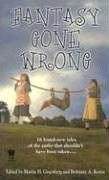
The upcoming anthology Fantasy Gone Wrong features a story by my wife, Chris, and it's just been singled out for praise in a Publisher's Weekly review.

Yahoo, Chris!

Friday, July 14, 2006

Another year gone

For me anyway. It's my birthday today. I'm looking forward to tonight's dinner (a bunch of the local writers at a local Chinese/Sushi place that's pretty good). There will be gifts, but I don't have huge expectations. I'm the hardest person on Earth to shop for, and if I want it and it doesn't cost a mint, there's a fair chance I already own it, or if I don't own it, I don't have any place to put it!

Which isn't to say gifts aren't fun and there might be some happy surprises, but they aren't what this is about any more. It's about friendship (not family this time, unfortunately, as most of the family is too far away to attend), and there aren't many things more important, or that I value more highly.

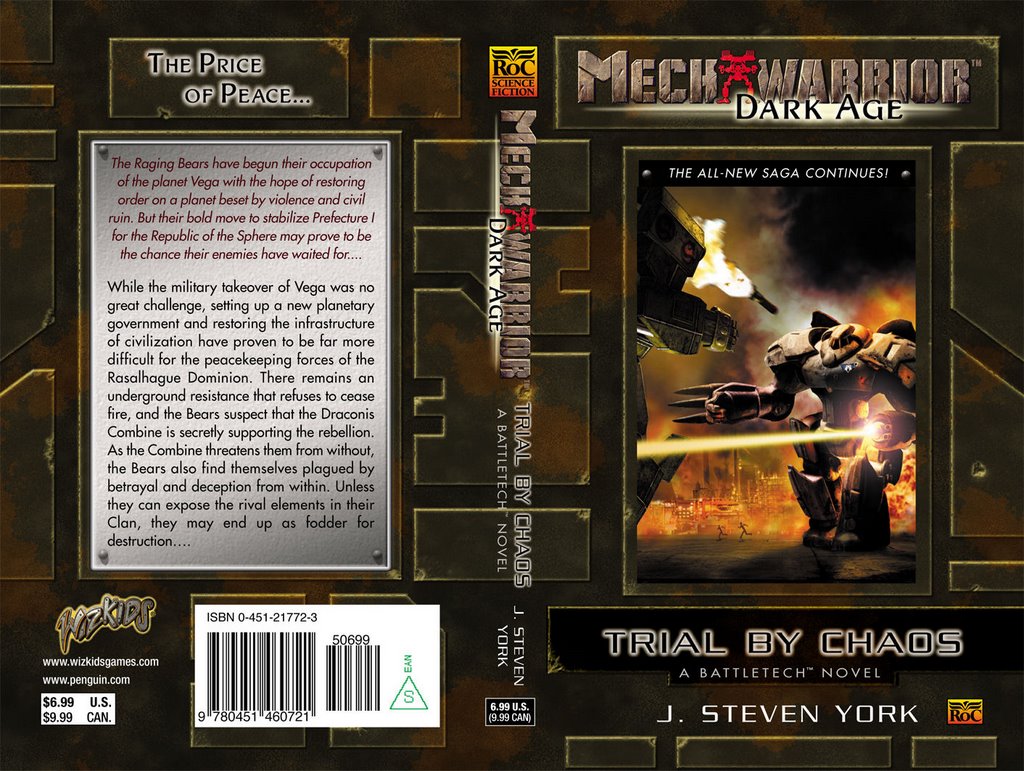
Overall, it's a pretty good life at the moment. I've got a wife I love. I live at the beach. I'm not rich, but I'm far from broke. I had four novels come out in the last birth-year (the Age of Conan trilogy in late 2005, plus my Mechwarrior book Trial by Chaos last month). The kids seem to be doing great.

Out there on the horizon, the world is going to hell, but here at Hangar 18, for the moment, knock on wood, things are good.

Monday, July 10, 2006

New Minions Warning -- er -- Alert


A fresh Minions toon can be seen tonight on the WB!

No, wait, the WB is toast. Maybe you'll find right now at Minions at Work instead.

MechWarrior Dark Age Q&A


This post is aimed for my MechWarrior readers. The rest of you can read or skip as you wish. Even MechWarrior readers should be warned that it contains some minor but important spoilers for Trial by Chaos (though I'm not sure how much sense they'll make out of context anyway, if you haven't read the book). If you intend to read it, you probably will want to do so first, then check back.

Now, on with the program.

I love fan mail (the polite and sane kind, anyway!), and try to reply when I can. A few days back, a comment here asked some questions that may have some wider interest, so I'm answering them in the form of a blog post.

I really loved Trial By Chaos, and I will be watching (hopefully reading :) ) the direction the Ghost Bears are headed for, but one thing has me chomping at the bit to find out more about... The Final Codex.. I know i am not the only MW junkie jonesing for it, any chance we will see it soon?

Thank you,
John Ingram


Thanks for your kind words, John. I'm very glad you enjoyed the book.

I can understand your curiosity about The Final Codex. I'm curious too!

Fact is, I was intentionally vague about The Final Codex, in part because I didn't want to reveal too much about it if it wasn't necessary to the plot, and in part because I wasn't sure when I proposed it how Wiz Kids was going to respond to the idea. In fact, my proposal for the book is careful to point out that we could end the book with the Codex being an obvious fraud, or leave it ambiguous.

To my surprise, they were very open to the idea, and I think you can take it as official canon that The Final Codex exists, or at least, it existed, and that the version the Ghost Bears see will have at least some of that text. But it's likely that they won't see all of it, and that some of what they see will be modified, and that there will be some creative additions made to support the agenda of the Freeminders and the U-Khan.

Of course, the question you're asking is, will the fans ever get to see the contents of The Final Codex?

I think the answer is a definite, "maybe."

The only copy we know for sure that still exists is with the Freeminders, but it suggests that the Ghost Bear Loremasters may have an copy somewhere. It seems probable that at one time all the clans had a copy. Now, it also seems likely that the Crusader clans might have had reason to "lose" their copies at some point, but perhaps some copies still exist among the Warden Clans, or even the Unnamed. These could well surface at some point. So maybe some more of the text will be revealed over time.

The problem being, the odds are slim that I will get to be the one to do it.

You see, one of the frustrations of writing the Dark Age books is that MechWarrior Dark Age is the ADD kid of book lines. Because the books chase along after the ongoing game releases, tournaments, and campaigns, I keep getting bounced from faction to faction, and books and characters that I'd love to follow up on get left behind.

For example, when I was writing "Fortress of Lies," I was setting up Duke Sandoval for his downfall, which did happen, in a book written by my pal Loren Coleman. I don't mind that, since Erik is really Loren's character anyway. But as I was writing the book, the story I really wanted to write was about Aaron in exile. I want to tell the story of what happens to him after he's had his butt kicked and almost everything he considers important stripped of him. From my point of view, he was already a fascinating character, but in exile, he just gets cranked up to 11.

But instead, I got to write about the Ghost Bears. Not that this wasn't, once again, a nifty book to write, but again, we've got a really interesting bunch of characters, and a situation that didn't resolve with the end of that story. I'd love to revisit them. But alas, I'm off to some other factions for the next book (I'm plotting to find a way to bring Aaron back, but I have no idea if that's going to happen).

So, if I get back to my little splinter of the Ghost Bears, it will be a while. Maybe some other writer will get to do it first, which would be disappointing for me, but par for the course.

None of this should be taken as a criticism of Wiz Kids or the wonderful people I work with there. It's just business, and I fully understand why they do things the way they do.

So, what can you do about the situation? Well, I have some suggestions that might at least help.

First of all, write Wiz Kids and Roc (the publishers) and let them know that you liked the book, and that you'd like a follow-up (and hopefully, that you'd like me to write it, but that's your choice).

Second, you can support the book. If it's successful beyond the norm for a MechWarrior book, then they'll have more incentive to publish a follow-up. Encourage your friends to buy it. Talk it up on the various MechWarrior, Battletech, and other forums where you hang out. Post positive reviews on Amazon and other on-line bookstores. Plug it on your blog, MySpace, or web page.

Now, I'll admit this is a steep hill to climb, but if you're like me, you like a desperate battle against overwhelming odds. So wipe that blood off your chin, slam the throttle against the stops, and tell them, "bring it!"

Thursday, July 06, 2006

Writers along the highway


Well, we're back from vacation. Obviously I didn't find time to post from the road, so I'll be backfilling here at some point. We had a good (if tiring trip). One enjoyable aspect was the opportunity to visit with writer friends, old and new, up and down the west coast.

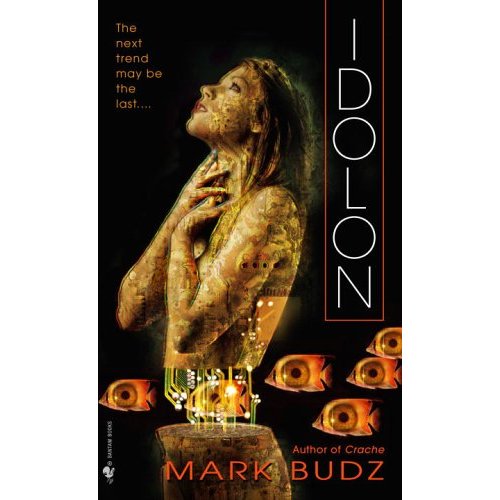
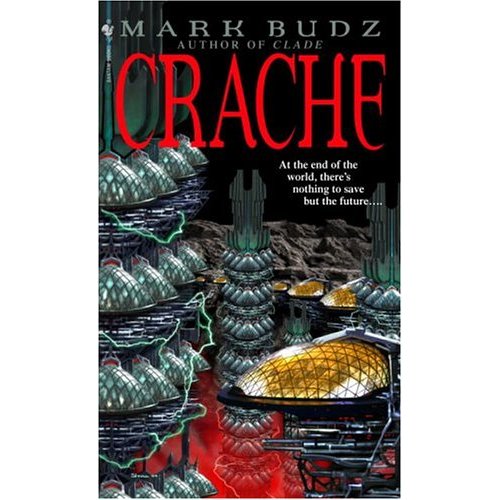
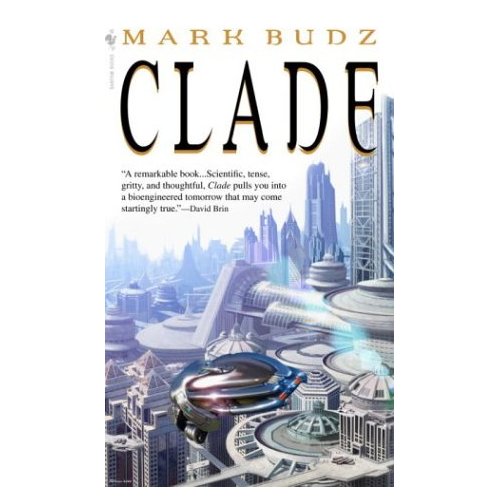
Our first stop was on the way down, where we stopped in the Bay Area long enough to have an enjoyable Chinese dinner with our friends Mark Budz and Marina Fitch. Both are novelists, and Mark gave me an advance-reading copy of his upcoming novel Idolon. This is Mark's third novel. His previous books, Clade and Crache were released to great critical acclaim (Publishers Weekly compares him to William Gibson) but just haven't gotten the reader attention they deserve. You should really check out Idolon when it's released this month, and see what you've been missing.

Then we trekked down to my old high-school stomping-grounds of North San Diego County and had a three-hour lunch (cue Gilligan's Island theme)with my old friend Gordon McComb and his wife Jennifer. Gordon and I used to collaborate back in my high-school and college days, and we did a number of student films together back in the day. My first professional publication (see a bit of it here and here) was an article in the old Science & Mechanics magazine written with Gordon.

Gordon went on to become a computer journalist and writer of technology books (everything from word processing software, to home robotics, to how to program your VCR so the number stops blinking). He was very successful, and even occasionally threw some work my way when I was still doing that kind of stuff. I knew he'd cut back on the writing lately, but I didn't know why.

Seems Gordon had people come up to thank him for his books, and then go on to describe the huge sums they were making as consultants based entirely on his work, far more than he was making on the books themselves! So these days, he's focused on his own consulting firm serving corporate clients and leaving the sucker-work -- er -- books, to somebody else. Gordon also continues indulging his long-standing interest in robotics, and has started his own small company to manufacture and market robot components, Budget Robotics.

Anyway, I haven't seen Gordon in years, and it was great to have a chance to catch up. Maybe I can convince he and Jennifer to bail out of Southern California before the Big One hits and move to the northwest (probably just in time for a volcano to erupt, but...).

Finally, on the way home, we stopped off in Eugene, Oregon for dinner with our friends Sean and Rose Prescott, and Adrian Phoenix. It's the first time we've seen Adrian since she sold her first novel, a vampire book, on a two-book deal to Pocket. Her novel will be used to launch an entirely new book line for Pocket, so they're obviously impressed. This is very exciting news, and overdue. Adrian is a fine writer with a unique voice. So, if you'd like a chance to get in on the ground-floor with someone who could be the next Anne Rice, you should look for the name Adrian Phoenix in months and years to come.