Showing posts with label Space. Show all posts

Friday, June 04, 2010

SpaceX Excels Through Patient Steps to Space

Today's successful first launch of SpaceX's Falcon9 medium booster and prototype Dragon capsule is a vindication of their patient, determined, building-block approach to space flight, one that resembles the original NASA method far more than what NASA has done since the cancellation of the Apollo program.

The Falcon 1 was a test program for everything that followed, an "X-Plane" if you will, but it was also designed as a functional commercial launch vehicle that could take small payloads to orbit. It had its share of failures before it succeeded, but it was designed to. The scale was small enough that failures were economically survivable, which probably wouldn't have been possible with a larger vehicle. It was also complete enough that if money had run out for further development, they still had a launcher to sell. Brilliant.

Upscale the structure of Falcon 1, put nine Merlin motors in the first stage instead of 1, one Merlin with a bigger nozzle in the second, multiply many of its systems, and you have the medium lift Falcon 9 that flew today. The approach of clustering to create a larger booster resembles the very successful Saturn Ib booster used on many Apollo orbital flights, manned and unmanned (including taking astronauts to Skylab, and the Apollo Soyuz mission). The Saturn I clustered and stretched tanks and engines used on previous launch vehicles (the Saturn Ib had eight first-stage engines).

But while the Saturn Ib was a mass of mismatched parts, the Falcon 9 is built more like a Lego toy, from a smaller number of common elements. The first and second stages use different versions of the same engine. The first and second stage use different versions of the same structure, and therefore overlapping tooling to build them, roughly half the work to verify the structural methods and performance.  The Falcon 1 and Falcon 9 share many common parts and systems.

Like the original NASA approach, Space X is designing launch vehicles independently of their mission. Falcon 9 can be used for satellite launches, to loft cargo in its Dragon capsule, and eventually astronauts (or paying passengers) as well. But it isn't limited to those things, or overspecialized in ways that cripple it for other missions (see the Shuttle as a worst-case in this department).

Today's launch isn't the end of the road. It's a mid-point in their master plan. The next Dragon capsule to fly will be fully functional on orbit, able to maneuver under its own power and do everything except dock with the space station. Docking is the next step. At some point, they also need to demonstrate reentry capability, and (if the capsule is to be used for manned launch) an escape rocket system.

But even that isn't the end. Incremental upgrades to Falcon 9 are certainly possible, and Space X eventually plans the Falcon 9 Heavy, a heavy-launch vehicle that straps two Falcon 9 first stages as boosters to the sides of a central Falcon 9.

In fairness, it should be pointed out that the building-block approach may have its limits. The Saturn Ib was a huge success, but the Russian N-1 Moon rocket (challenger to the mighty Saturn V) was a colossal failure. It may not be fair to make comparisons though. SpaceX shouldn't suffer the political snafus and pressures that hamstrung the N-1 program, and the engineering problems are far better understood (as are the tools for predicting and solving them).

Today, Space X has announced that they're in early talks with NASA on the development of a future "super-heavy-lift" vehicle. Would this be a Falcon 9 heavy with four strap-ons, build on some further upscaling of the core vehicle, or would it be the start of a new cycle of development built around larger motors and structures? It will be exciting to find out.

Friday, June 05, 2009

Building a Moon Rocket From Common Household Materials, Part 2


If you haven't seen it already, you can see part one of the article here.

Well, yesterday, just as I was starting to relax a bit, that I had 24 fewer hours to finish my Saturn V model than I planned. So it's been a sprint to get it done in time, but (except for some drying glue) it's done, or as done as it's going to be.

The first couple pictures show the nearly complete rocket. The lower stages are done, though there are still rubber bands holding things on while the glue dries. The interstage (the lower taper) between the second and third stage is missing its final roll-markings, and actually that whole part of the rocket is just dry fitted together, and awaiting final gluing and assembly.

From start to finish this has been a question of compromise, but due to time constraints, I didn't detail it as much as I'd hoped to. It's got none of the external tunnels or rocket housings I'd hoped to add. The service module has only one of its twelve thruster nozzles, I never got around to adding nozzles to the escape rocket, and the engine nozzles were never painted silver (the protective covers for the engine nozzles were nearly an identical shade of red to the cups I used, so this isn't a huge issue).

But also along the way, mistakes were made. The biggest one is that through some error of measuring or calculation, the first stage/second stage joint is way too low. The first stage should be longer than the second. Actually, that could be the problem. I may have measured from the wrong end when I put in the lower second stage wrap. During assembly I kept turning the tube upside down and back again for various parts of the assembly, and that got confusing.


There are other smaller things. One of the flags is a little crooked. There are small gaps and imperfections I wish weren't there. A couple of tank wraps I'd planned to add got skipped for time (and one of the because the first stage was too short, because of my mistake, for it to look right.

Several things about the interstage between the second and third stages are less perfect than I'd like them to be, including a staggered joint in the roll pattern that should be straight.

I kick myself about these things, and yet I know that probably nobody at this party is going to know enough to notice, and there's just not doubt, looking at this thing, despite its flaws, that it's a Saturn V. It has the look, even if the details are wrong.


It also has size going for it. One problem with most Saturn V models, no matter how detailed and accurate they are. They just don't communicate any of the sheer size of the rocket.

The Saturn V was 362 feet tall. That's well over twice the height of the 10 story hotel the party is being held in. Refer to what I call the "shock and awe" low-angle shot of the incomplete model above. The fact that even I (being six-foot six inches tall) still have to look up to see the top of the model (if it's sitting on the floor) makes a huge difference. Put it on a table or pedestal, and it really reminds you that this is a a model of something big.

The details for tomorrow's display are still being worked out, but due to limited ceiling height in the party room, it will likely end up sitting on the floor tomorrow. I really wish there was room for even a short pedestal. Oh, well.

These last two pictures show the final model.

I'm really nervous now that something will happen to the model tomorrow. Parts of it (especially the fins) are fragile, and could be damaged if someone knocks the thing over, kicks it, or moves it without knowing what they're doing. I'm really hoping to get the model back intact after the party.

As I said before, we might be able to donate or loan it to a local school for educational purposes. Failing that, it will probably end up hanging (sideways) from my office ceiling. In fact, since school is out (and due to budget crunch, I don't know how much summer school they're having this year), even if it does go to school, it may have to be stored hanging from my ceiling until fall.

I'll let you know how it goes.

Wednesday, June 03, 2009

Building a Moon Rocket From Household Materials


This is a little off the usual topics around here, but... (Actually, given that I've done a lot of posting about space issues, maybe not so much.)

The beach hotel where my wife, Chris works her day-job is celebrating it's 40th anniversary this month. Given that this closely coincides with the 40th anniversary of Apollo 11, the moon landing is one of the major themes for the party. Somehow I got talked into (or did I talk myself into it?) building a model Saturn V moon rocket as a central decoration.

Somehow I got the great idea: We can get one of those cardboard concrete form tubes (used to pour piers and the like) at Lowes and build it around that! It'll be easy and cheap.

Yes, this is being done on a budget of close to nothing. So far I've spent about $30 for materials. No, I'm not being paid for my time. I'm nuts.


Fortunately, there were lots of free resources on the web to draw on, especially for the capsule and escape tower. There are free paper models on the web that you can print out, cut out, and (with only a hobby knife, some glue, and the skills of a brain surgeon) turn into a nice 1/48th scale (just the size I needed) model of an Apollo space vehicle.

Actually, there are rather sketchy models of the whole thing in 1/48th, and better ones in smaller scales. I've ended up using bits of at least four different paper models. But only bits. Mainly the capsule "skin" and the shrouds that connect the stages and cover the four outer engine bells at the bottom. Everything else has been engineered from scratch, scrounging and adapting as I went along.

I needed this thing to be stronger and more durable than a paper model could be, so the entire upper stack, from the upper interstage to the end of the escape tower is supported by a "spine" of wooden dowel. You could put your eye out with the escape tower, but it isn't going to break off.

The interior structure is full of foam-core-board rings and plates, and this material is also used for the fins. All of the black markings are hand-cut bits of black posterboard or craft-board individually glued in place. The engine bells are carefully (we went through three stores measuring to find the right ones) selected plastic cups bolted to a foam-board base-plate. Because the cardboard base tube isn't EXACTLY to scale, and my hand-rolled third-stage tube also wasn't precise, the lower shroud had to be enlarged and modified.

There are well over a hundred (maybe two hundred) parts at this point, and most of them have been designed from scratch, hand-cut, and fitted.

This isn't a museum model though, and it has to be done on a deadline, so like a Hollywood prop, it's a rolling compromise to time and materials. I couldn't find a corrugated material like I wanted to use on the tank wraps, so I had to compromise and use bands of flat poster board.

I may not get around to adding the service module thruster nozzles (twelve tiny cones that would be cut from round toothpicks.)

I may not add many of the service tunnels, ullage (once again, my vocabulary exceeds my spelling checker, a small rocket-motor used to push liquid fuel to the back of the tank of an in-flight vehicle before main-motor ignition and stage seperation motors, and other "bumps" that cover the real Saturn V.

Still, it's nearly 8 feet tall, and even incomplete, the iconic look is there. Get some more paint and a few roll markings on it, and any baby-boomer will know exactly what it is.

I don't know what will happen to it after the party this weekend. Presuming it survives the proceedings (uncertain, but I hope), I hope to get it back. Maybe it can be donated to a local school, or failing that, it could end up hanging from my office ceiling.

In any case, I am very much a child of the space age. Building this is my homage, my totem (in more ways than one) to the anniversary and one of humankind's greatest achievements.

See part two of the article and the finished rocket, here.

Wednesday, April 01, 2009

Ebooks in space


The other day NASA took a mock up of the new Constellation manned capsule to the Washington mall to show it off, and I studied the press images with interest. I'd seen a rather less detailed mock-up recently at the NASA visitor's center at the Kennedy Space Center, but this gave a much better sense of what the real item will be like, and the fact that it was sitting on a flat-bed truck provided an unusually good reference for scale.

I was at once stuck by how large it is, and how small. Certainly, it's big compared to the Apollo capsule that the reentry body is based on, and big enough to provide a "wide load" for the semi-truck. But it's still very small when you think of some of the tasks put before it.

Constellation will replace the shuttle in taking astronauts to orbit, and hopefully will eventually get us back to the Moon. But long-term plans are also to use it for for extended missions to Mars, or possibly to near-Earth asteroids. Such missions would require astronauts to live in the capsule for many weeks or months. Even Constellation lunar missions may have much more extended stays than the longest Apollo mission. For a Mars mission in particular, the Constellation looks tiny.

It's one thing to be crammed into a tight space with several other people for a week or two. Human beings can endure almost anything for that length of time. But when this stretches to months or even years the psychological stresses can be intense. Boredom, isolation, lack of privacy, all are concerns on long duration flights, even in much roomier environments like the International Space Station.

Several years back I had the pleasure of watching the IMAX film, "Mission to Mir." One of the great things about IMAX is the level of visual detail, and the sense of presence that it gives you. You're free to ignore the action at the center of the screen and study the dusty corners of whatever environment is being filmed.

This was of special interest here, as Mir was quite an old space station at that point, and it was anything but a sterile environment. It was literally a house, or maybe more properly, a dorm, in space, and it showed. Objects showed obvious signs of wear and use. Everywhere you saw signs of human occupation: notes, pictures, personal objects, signs.

Given the eventual sad decline and death of Mir, this could be taken as signs of decay, but my reaction to it was joyful. People weren't just visiting space, they were living there! It was an important distinction from the space missions of my youth. Even the Skylab space station missions seemed mostly to have been carried out with a sense of military pragmatism.

One scene I found of special interest featured a visiting astronaut showing off their tiny personal quarters. In particular my eyes were drawn to a small shelf full of well-worn, well-loved paperback books (held in place with some kind of strap or bar, in case you were wondering). The 'naut explained how every new visitor added to the library, and left the books behind for future occupants of the station.

Since every pound of mass sent to orbit is literally worth its weight in gold, these are probably some of the most expensive books I've ever laid eyes on, and they were likely among the most appreciated.

Which brings me back to the Constellation. The astronauts who go on those long missions will almost definitely have one advantage no previous space-traveler has had before: a space-rated version of the Kindle or some similar ebook device loaded with an entire library of books.

Yes, they'll have other entertainment technological advantages as well. They'll certainly have an iPod, or something like it, loaded with music and movies. There will be personal computers, possibly game consoles, and maybe even simple virtual reality to help them escape their little technological world from time-to-time.

But I think books have a unique power to engage the mind and take the reader away from whatever their reality may be to a different mental place. I think books will be a great source of comfort in the long void between the worlds. It makes the ordeal of spending months on end jammed into that little tin can seem just a little more thinkable.

Saturday, March 28, 2009

The Shuttle Disaster that wasn't -- Barely


I follow space flight fairly close, but here's a chilling bit of history I wasn't familiar with. 21 years ago, just after the return to flight after the Challenger explosion, the Space Shuttle Atlantis came dangerously close to being destroyed by the same sort of tile damage that later destroyed Columbia.
Except that, in many respects, the tile damage to Atlantis, also caused by an insulation impact during launch, was actually worse than the Columbia accident. More than 700 tiles were damaged, and one tile in a critical area was completely destroyed, resulting in melting in the exposed aluminum underneath.


And because of a communications blackout on the top-secret military flight, NASA remained blissfully ignorant of the damage, even while mission commander Robert "Hoot" Gibson was looking at images of the tile damage and thinking, in his own words, "we are all going to die."

I just read the story on the web site Space Flight Now. Here's the gist of it, with some added insights of my own (based in part on the rather mundane picture from the NASA archives seen above):

In 1988, the second post-Challenger mission, STS-27, was launched with a secret spy satellite on board. 85 seconds after launch, a chunk of insulation broke loose from the nose of the right solid-rocket booster and struck along the right side of Atlantis.

It isn't clear from the story if the discovery of tile damage was accidental, but it appears so, and the astronauts were extremely alarmed by what they saw. The insulation had impacted near the nose, and resulted in a triangular-shaped cone of damage all the way down the right side of the spacecraft, from the nose almost to the rear of the wing. You've read Gibson's immediate reaction above.

But because of limitations on communications, the crew were unable to properly communicate their concerns to the ground. During military missions, strict limits are places on communications with mission control to insure secrecy. Anything that might even remotely reveal information about the payload, its characteristics, purpose, or orbit, are closely guarded. One hard-fast rule in this case was, no video.

Finally, reluctant permission was given to send encrypted video of the damage to the ground. But the encrypted video system was black and white, low resolution, and could only send one frame every three seconds or so.

It's also interesting that the only photo I could find in the searchable NASA photo archives referencing the damage is the one above. It shows the crew attempting to repair a video tape containing the video of the tile damage. Yes, that is a roll of duct tape floating there.

The implication I take from this is that video was recorded (using the shuttle's robot arm) of the damage was recorded on tape in order to be converted into encrypted format and sent back to Earth. Only the tape jammed somehow, and... This is a SNAFU of historic proportions. You can read a million things into the bemused expression on the mission specialist's face at right. I like to think he's something like, "we're f*cking about to die, and it all comes down to duct-tape and a Betamax."

Because of the poor quality video, engineers on the ground thought they were just looking at shadows on the surface of the tile and assured the crew there was no danger. The astronauts knew otherwise, but did not attempt to convince the ground, perhaps unaware of their line of reasoning. It was nothing a little open discussion couldn't have fixed, but apparently the communications restrictions didn't allow for that, or at least, encourage it.

And so, the mission continued as planned, with NASA doing nothing (not that there was a lot that could be done, since no repair tools or materials, besides that duct tape, were carried, nor had even been developed at this point), and the astronauts soldiered on, plauged by doubts that they would survive reentry.

Upon landing, they discovered the damage was even worse than the astronauts had realized. Without the new cameras and extension boom now routinely carried on the Shuttle, there was no way to image the entire underside of the shuttle, including large areas of damaged. In told, more than 700 tiles were damaged, including the missing tile, located under the orbiter's nose, an area subject to high heating. Upon landing, it was discovered that the exposed aluminum under the tile had actually begun to melt.

If it had burned through, a literal torch of plasma would have cut into the shuttle and its fragile systems underneath, quite likely dooming the spacecraft. Perhaps, as with Columbia, one of the first warnings would have been the pressure in the landing gear tires, as heat caused them to expand, and finally explode. Except, the indicator might have been on the front tires, rather than the rear.

It didn't happen though. One bit of luck, the missing tile exposed a mounting plate for an antenna, and so was thicker than the skin only inches away. That one detail may have saved Atlantis and its crew.

Post flight, NASA apparently minimized the damage and the risk to the crew. Secrecy may have been an issue, but it's almost impossible to ignore the potential CYA factor. A near disaster only two flights after Challenger, following what was supposed to be a complete safety overhaul of the program, could have grounded the shuttle again and heads were certain to roll. It's interesting that, even now, there are apparently no photos of the tile damage in the searchable on-line archives, though they exist (Space Flight Now has a few).

Of course, if Atlantis had been lost, the shuttle would have definately been grounded, and it very well could have been the end of the shuttle program, and perhaps American manned space flight. That's one grim alternate universe.

But in another one, NASA learned from the mission and launched an immediate review of the potential for tile damage. Methods might have been developed for routine examination of the tiles during each flight. Improvements might have been made to reduce foam shedding and ice build-up. Repair tools and techniques might have been developed. And in that world, Columbia might have survived, or at least its crew might have been rescued by an emergency launch of a second shuttle.

But that didn't happen.

We
are their grim alternate reality.

The shuttle is scheduled to be retired next year, and I will miss the capabilities we lose when that happens. But I will not miss the shuttle itself, with its inherent design flaws and dangers. There's no reason that the Constellation system that replaces it shouldn't be far safer for the women and men who fly in it.

Let's hope that's so. Space is a dangerous business, and more people will die in its conquest. But those deaths shouldn't be tragically avoidable, as was the case with Challenger, Columbia, and almost, Atlantis.

Saturday, July 12, 2008

Countdown to Nowhere


(This is a follow-up post to yesterday's "Buzz Off" which concerns astronaut Buzz Aldrin's recent statements that shows like Star Trek led to the decline of support for the space program. If you haven't read it, go there first.)

I've gotten a lot of support and "attaboys" from people who read "Buzz Off," but it turns out I didn't win over everyone. Fact is, I thought this over pretty carefully, and there's a lot of stuff I DIDN'T put in the original post, because I didn't think it was necessary given the basic
facts. More would have just been clutter.

But since the facts weren't as obvious as I supposed, let's look at another major
problem with the Buzz Aldrin theory. I don't think the historical time-line supports it.

At first glance, though, you might think the dates line up well. Star Trek was on TV from September 1966 through September 1969. The collapse of the space program's support is really centered around 1970. (The live TV broadcast from Apollo 13 wasn't covered by any of the major networks live, and it flew in April 1970. Apollo 20 was canceled in January of 1970. Two more Apollo missions were canceled in September of 1970.)

So the dates seem close, but I don't think it holds up to scrutiny.

First of all, remember that Star Trek was a failure in its broadcast run. It was nearly canceled in September of 1968 (while Apollo 8 had the world's attention, and Apollo 11, which drove the country (and the world) into a frenzy was nine months away. In fact, the decision to pull the plug on Star Trek had to have been made just about the time Apollo 11 landed, and the program was at the peak of its popularity and public interest.

Star Trek REALLY didn't take off until it was in syndication and college kids started watching it. I don't have a good date for that, but I suspect we're talking 1971 or 1972, when the smoking gun had long-ago gone off.

But the decisions to pull the trigger on that gun had to be made earlier.

Congressional support had to deteriorate sometime well before the cuts started, and the decision not to cut-in live on Apollo 13 probably resulted from viewership numbers on Apollo 12, which flew in November of 1969.

Of course, Apollo 12 blew out its TV camera shortly after landing, and that probably accounts for a lot of any ratings tumble. You can hardly blame that on Star Trek. (Ironically, almost without exception, Star Trek never showed TV cameras being taken along by its explorers.)

In any case, if Star Trek somehow poisoned the U.S. public on the space program, it did it as a low-rated show with a limited audience. And indications are that, during both first-run and in its re-run "boom" period, the audience for Star Trek largely consisted of people under 21. The voting age was still 21 at this time, and wasn't lowered to 18 until July of 1971. So as far as political influence, it's hard to see how it ever could have had any significant impact at that point in time.

The first evidence that Star Trek fans had political clout didn't come until the first Space Shuttle was renamed ENTERPRISE, following a letter-writing campaign to the Ford White-house by fans. I don't have a date for this, but it happened sometime between when President Ford took office in 1974 and the Enterprise roll-out in 1976. Since construction didn't start until June of 1974, and its original name was "Constitution," and Ford took office in August of '74, it would not likely have been any earlier than that. It's very likely that the reduction in the voting age was a factor here.

Regardless of the date, this hardly supports any lack of support or interest in the real space program by Star Trek fans. Quite the contrary.

On the other hand, NASA's internal grumbling and foot-dragging on the matter is a fine example of how they loved to shoot their public image in the foot. Here was a great opportunity to connect their mission with the public, and rather than exploit it to the fullest, they minimized it as much as possible.

I just don't see any evidence here that Star Trek harmed the space program in any way.

Of course, Aldrin wasn't specific that he was talking about Star Trek, but there just aren't many other on-air TV candidates for killing support of the Space Program.

Lost in Space started (and ended) a year earlier than Star Trek, and had a much bigger audience than Star Trek, but there was no beaming there. There were aliens (often very silly aliens) and interstellar travel (though the science was so weak that I don't recall any kind of faster-than-light drive ever being mentioned). But most of the signature hardware, robots, space-walks, jet packs, surface crawlers, and a very LM-like landing vehicle, were all right off the NASA drawing boards at that time. It was more futuristic and advanced, but in its own way, much more realistic than Trek.

The British series UFO (which featured a modest and fairly believable lunar base) didn't reach U.S. syndication until 1971 and 72. The follow-up Space 1999 with a much bigger Moon base (and some screamingly bad science) didn't show up until 1975.

Other than that, I can't think of anything (other than some Saturday morning cartoons) that qualifies. Feel free to correct me if I've missed something significant.

Meanwhile, all the stuff that Aldrin frets about, teleportation, faster-than-light travel, and so on, had been popular staples of print and comic science fiction since at least the 1930s. Somehow, the U.S. space program got off the ground anyhow (mostly by people who had at
some point read plenty of the stuff.

And we can't ignore movies. Flash Gordon and Buck Rogers were rocketing off to alien worlds in theaters as early as 1936 (and on radio starting in 1932). Heck, even Duck Dodgers used a teleporter in his first 1953 cartoon appearance!

None of the offending concepts or devices was invented by Star Trek, or any TV show. It predates broadcast television entirely.

Really, looking at the evidence, if the time-line supports anything at all, it's the idea that cutbacks in the Apollo program (and news coverage of same) may have contributed to the renewed popularity of Star Trek in syndication in the early 70s.

If the real space program wasn't going to give us the stars (or even the Moon again, or Mars) anytime soon, we'd watch Star Trek and dream until it did.

That just makes more sense than the idea that B led to A.

But there's a subtext in the time-line the supports more significant factors.

At least some of the press (and the public's) interest in covering the Apollo program has to be traced to the camera failure on Apollo 12. Apollo 13 might have turned that around, but it never made it to the moon, and was covered for entirely different reasons.

Support for Apollo in congress was weakening by early 1970, when Apollo 20 was canceled. The next two cancellations happened after the near loss of Apollo 13. By then, the risks were obvious, and there's no political stock to be gained in backing a losing horse. Better to end the program a winner.

It was also obvious by then that the press was more interested in covering failures in space than successes. Lose, lose. Not much here you can blame on Star Trek.

Combine this with the growing cynicism about government, and the huge cost of the Vietnam war (which lead directly to the cancellation of the Air Force's manned space program before it even started), and there just wasn't anything to be gained politically by backing NASA. Again, not Star Trek's fault.

The facts aren't there. The logic isn't there. Star Trek didn't do it. No science-fiction TV show did. If anything, Star Trek has been a positive influence on people's interest in space.

So, anybody want to start a write-in campaign to name the first, manned, Orion crew-capsule to reach orbit (no test models this time!), Enterprise?

More writings about the Moon:

Closely related to this topic, I have a couple of previous posts about the Moon and the Apollo program that you should check out:

Buy Me The Moon
Why the Apollo program didn't cost nearly as much as most people think it did, and how we might trade certain -- luxuries -- for a Moon base or a Mars program.

1200 Days On Mars
People say there's no reason to return to the Moon. "Been there, done that, got the tee-shirt." Well, we haven't been there, haven't done that, and we don't even know where the tee-shirts are sold. How we've barely touched the Moon, and how it compares to our current unmanned explorations of Mars.

Friday, July 11, 2008

Buzz Off


Don't you hate it when one of your childhood heroes says something so profoundly wrong and stupid that you just have to call them on it? Unfortunately, it just happened to me.

The hero in question is Apollo 11 moon-walker Buzz Aldrin. Ironically, I ran across this story on the US Sci-Fi Channel's "Sci-Fi Wire" news site. If any of the space sites or major news sources picked it up, I didn't see it. Aldrin was shilling his new National Geographic Channel show, "Unseen Moon," at the annual TV Critics Press Tour.

Anyway, Aldrin went on about how "unrealistic" science fiction television shows caused the public to lose interest in the space program. He doesn't name names, but he keeps mentioning "beaming," which seems like a reference to Star Trek. But he also is quoted as saying something about the shows being on "today," which kinda points a finger towards Stargate Atlantis, the only other current show I can think of that "beams" people.

Or maybe he's confusing reruns with new shows, or is being unclear about the time. Because, the public started losing interest in the space program before half the people working on Atlantis were born.

So I'm going to assume he's talking about Star Trek, since its the best known and most iconic space science fiction show, and its history somewhat parallels that of the space program.

Just so's you know I'm not taking him entirely out of context, here's what he's quoted as saying:

"I blame the fantastic and unbelievable shows about space flight and rocket ships that are on today. All the shows where they beam people around and things like that have made young people think that that is what the space program should be doing. It's not realistic."

and later in the article:

"But, if you start dealing with fantasy and beaming people up and down and traveling seven times the speed of light, you are doing damage. You're not helping. You have young people who have got expectations that are far unrealistic, and you can't possibly live up to the expectations you have created in young people. Why do they get bored with the space program? That's why."


Can't have those young people stretching their imaginations and developing unrealistic expectations, can we? Good grief. Next thing you know, he'll be going on about the sins of dancing and the dangers of "the rock and roll."


Seems to me, Buzz, that if some young people, scientists and engineers, had not developed unrealistic expectations based on the unrealistic works of Jules Verne and H.G. Wells, there might never have been rockets into space.

Though Verne is credited with being highly predictive of the Apollo program in many respects, he shot his adventurers to the moon with a giant cannon, something even an engineer of the time could have shown was impossible. Verne, in turn, scoffed at Wells, who sent his travelers to the Moon using an "unrealistic" anti-gravity metal. (This debate is not a new one.)

Many later space program participants also cite the Mars books of Edgar Rice Burroughs as inspiration, which were even more fantastic and romantic. His hero, John Carter, travels to Mars through some kind of ill-defined astral projection, and his Mars is populated with all manner of fantastic creatures and races, including one that happens to have hot (yet egg-laying) females with whom Carter can conveniently interbreed. (Thus, I suppose, clearing the way for Captain Kirk to later bed-hop across the galaxy.)

And of course from there we can go the the Lensmen books of E.E. Doc Smith, or the juvenile novels of Robert Heinlein, for example. Smith's books are as fantastic, in their way, as Burroughs. Heinlein tried to be more realistic, but his books are still full of aliens and rockets flitting from star-to-star.

Yet this sort of stuff has managed to somehow inspire generation after generation of scientists, engineers, pilots, space advocates, and yes, even astronauts. In fact, many of the current crop site Star Trek, and the even-more-fantastic Star Wars, as inspirations.

The fact is, Buzz has it all wrong. Realism isn't the issue. Scientific accuracy isn't the issue. Science fiction is inspiring to those who make real space travel possible, and it's inspiring for entirely different reasons.

Star Trek offered hope that humans could go to the stars, that there might be other life in the universe, and that we would find it, and it would ultimately be good. It also offered the hope that humans could solve enough of our internal struggles to survive and work together to make it possible.

The how of getting there isn't important, it's the hope, the wonder, that we could. Once you've embraced that, you don't look around and say, "well, I can't beam to space, so I'm not going." No, you go and find the next nearest thing you can, the Shuttle, Spaceship One, the new Orion vehicle, and you try and get on it if you can.

And if that isn't good enough, you roll up your sleeves and try to make something better. Not the Enterprise probably. Not a transporter. But better.

Or at least, you hope somebody else does, and you're much more likely to support them if they say they're trying.

No, I'm afraid Buzz has it all wrong.

Not that I can blame him for his frustration, maybe even anger at our lack of progress in space, and the public's seeming apathy towards it. It's just that he's lashing out in the wrong direction.

The reasons for the public's lack of interest are complex, and I don't think there's one single thing to blame. But if fingers are to be pointed, I think you can start with NASA's stunning ability to counter-promote itself. We're not just talking inability to promote here. We're talking an exhaustive 40+ year campaign to dehumanize its astronauts into bland, interchangable drones in the public eye, and to make some of the most exciting voyages of adventure in human history, seem boring.

Buzz has always been one to buck that trend. Unlike some of the Apollo astronauts, he's not been reclusive, or allowed himself to be one of NASAs obedient PR pawns. He's been out there, in the public eye, pushing himself as an individual, and yeah, even licensing his image for toys, models and other trinkets.

Even signing on to host TV shows. Yeah.

And I've always backed him on that, because the astronauts should be rewarded for their courage, celebrated for their place in history, and appreciated as the deep and complex human beings that they are. If that means Buzz Aldrin Action figures, well, that's fine, because I want a Buzz Aldrin action figure, and I want one for my grandkid too. I want to know their stories, the good and bad of them. If they have something to say, I want to listen. And if they make a little cash along the way, more power to them. Who do I make the check out to?

But this time, Buzz is just wrong. He just doesn't know what he's talking about.

We should be thankful for Star Trek and Stargate and Star Wars and all the rest, that kept people thinking about the future, thinking about the stars, thinking about the planets, and not thinking about "if," but only "how, and when?" Because it's only through that spark of hope that we'll get there, however we do it.

And I'll take that spark any way I can get it, thank-you...

(While most responses to this post have been supportive and positive, not everyone was convinced. So I put some of my cast-off arguments into a follow-up post that I hope will put the matter to rest. Check it out.)

Tuesday, November 13, 2007

Buy me the Moon


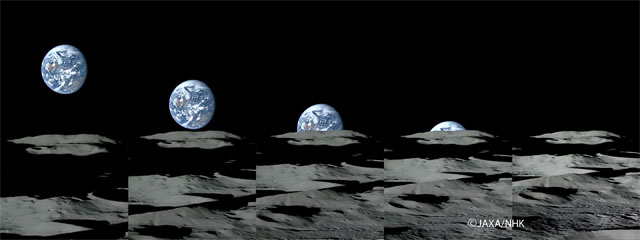
(Earthrise photos taken by the Kaguya probe, credit: Japan Space Exploration Agency)
As I've said before, people constantly over-estimate the cost of the Apollo lunar program. Not that it was cheap. It was a huge undertaking. But compared to many of the things big economies (like we have here in the United States) do, it just wasn't that big.

Today, a report by congressional Democrats pegged the cost of the wars in Iraq and Afghanistan so far at 1.6 Trillion dollars. The report is controversial, and Republicans are already calling for a retraction, but consider how it compares to the Apollo program.

By comparing various estimates as to the program's cost and running through cost-of-living calculators to adjust for inflation, I come up with a number of about 143.5 billion in 2007 dollars. Just for safety and simplicity, round it up to 160 billion dollars.

Now, keep in mind that a trillion has three more zeros in it than a billion. So if the report is right, our adventures in the middle-east have cost us as much as ten Apollo programs, and if its predictions are near correct, it will cost us over twenty Apollo programs by 2009.

But as I said, the report is controversial. Let's say it's wrong. Let's say it's a wild lie that inflates the actual cost of the war by a factor of ten. Then our war-of-the-moment has only cost us one Apollo program, and by the end of the decade, shouldn't cost us more than one or two more. That's much better.

Oh, one other factoid to consider. The Apollo program ran for 14 years, 1961 through 1975. We invaded Afghanistan in 2001 and the second Gulf war started in 2003. The report's projections only go through 2009. The Apollo program not only cost far less money, it was spread over a much longer time.

By the way, if you're curious, according to a recent Washington Post article, the inflation-adjusted cost for the Vietnam War was 549 billion dollars. And that was money well-spent, wasn't it?

A lot of people like to say we can't afford to go to Mars, or back to the Moon. Maybe they're right. But if so, it's important to consider why we can't afford it.

Hey, I've got an idea! Let's just cancel our next war and just build a Moon-base instead. Or to put it another way...

For decades, it's always stuck in my craw when I'd hear somebody say, "if we can put a man on the Moon, why can't we do 'X.'" Well, I think it's time to finally put that one to rest. I propose this replacement:

"If we can put an army in Iraq, why can't we put a man on the Moon?"

Wednesday, July 04, 2007

Life Imitates Art


NASA has just released some exciting new images taken by the Cassini space probe of Saturn's moon Hyperion. As many fantastic moons as we've seen in the Jupiter and Saturn systems, they continue to offer visual surprises.

Hyperion, as it turns out, is an icy sponge of a moon blasted with craters and impact damage. But it's my understanding that the most striking visual feature comes not from impact, but from melting. Scientists believe that dark material on the surface of the moon is heated by the sun, thus causing it to melt its way into the surface. What makes this moon look so strange is that it's too small to be pulled into a spherical shape, and so "down" as defined by gravity isn't what our common sense tells it should be.

Our lifetime of experience on Earth tells us that "up" is usually at right angles from the ground. There are exceptions, of course, but then we're usually standing on a hill, mountain, or slope deviating from the surrounding terrain, and under sky, both of which usually allow us to define "flat," which is in turn 90 degrees from "up" and "down"

Not so on Hyperion, where "down" is going to point pretty much towards the center of mass. So dark objects melting into the ice near the ends of its oblong shape will travel "down" at a sharp angle to its surface. This is the first time I can think of that we've seen this so vividly illustrated.

You can think of Hyperion as two hills joined bottom to bottom. While those arches of flat planes at either end look to be relatively flat to the surface, I suspect to an astronaut standing on the surface they would appear to be steeply sloping upwards towards the ends of the moon, and from an observer out in space (like Cassini) the astronaut would appear to be standing at an angle.

Yet another example about how "common sense" may not serve us well once we move beyond the environment we evolved in.

But I was also struck with how the image reminded me of something more familiar, New York's famous Chrysler buildings (in my opinion, one of the most beautiful pieces of design in the 20th century).

It's impossible to know what architect William Van Alen was thinking when he designed the arches of that famous spire. Could some part of his mind been imaging how a building so massive, so magnificent, so lofty, would actually defy the Earth itself? Could he have have envisioned a building that, so attracted only by its own gravity, its upper reaches would be drawn towards the center of its own, mighty, mass?

Okay, that's probably not what he was thinking, but it's a nice dream. I think I'll keep it.

Tuesday, May 22, 2007

1200 Days on Mars


There was exciting news from NASA yesterday as the Spirit Mars rover has accidentally discovered silica-rich soil, a mineral that likely could not have formed without the presence of water. It's a strong further clue that Mars was once warmer and wetter than it is today, and might (or might once have) supported some form of life.

Which is pretty cool stuff, but it isn't really what this post is about. What struck me was a quote from Steve Squyres of Cornell University, leader of the rover team in a TimesOnline Article. He says, "This is a remarkable discovery. And the fact that we found something this new and different after nearly 1,200 days on Mars makes it even more remarkable. It makes you wonder what else is still out there."

Indeed. We've been poking around the planet we live on for many thousands of years and it continues to surprise and mystify us. Which is why I'm always appalled at detractors who dismiss the idea of a return to the Moon because, "we've already done that."

What surprises me most is that I hear this not just from opponents of space exploration, but from space advocates as well. Many of them simply see the Moon as a nothing more than a distraction from their real goal of a manned expedition to Mars. "Been there, done that, got the tee-shirt and some rocks. Move along. Nothing to see here."

Bull.

Now, admittedly, the Moon is in many ways a far less interesting and complex place than Mars. But we still know so little about it. The assumption that the Apollo missions "saw everything there is to see" is simply absurd, and some people don't appreciate how short a time they were there, and how little they saw while they were there. First, let's look at the numbers:

Apollo 11

Time on Surface: 21 Hours, 36 Minutes
EVA Time (time spent outside the spacecraft actually doing something): 2 Hours, 32 Minutes

Apollo 12
Time: On Surface: 31 Hours, 31 Minutes
EVA Time: 7 hours 45 Minutes

Apollo 14 (Apollo 13, of course, suffered a crippling explosion on the way to the Moon and was unable to land)
Time on Surface: 33 Hours, 30 Minutes
EVA Time: 9 Hours, 22 Minutes


Apollo 15

Time on Surface: 66 Hours, 55 Minutes
EVA Time: 18 Hours, 33 Minutes


Apollo 16

Time on Surface: 71 Hours, 2 Minutes
EVA Time: 20 Hours, 14 Minutes


Apollo 17

Time on Surface: 75 Hours
EVA Time: 22 Hours, 4 Minutes

So that's it, a total of about (by my sometimes shaky math) about 80 and one half hours on the Moon. And a lot of that was spent climbing up and down ladders, opening and closing hatches, stowing and unstowing gear, figuring out how to walk and work (every flight was essentially a training flight). Three days and change. Almost seven man days, if you're generous.

Yeah, that's just the manned part, but it isn't like there's a huge body of unmanned exploration to back it up. The U.S. sent seven unmanned Surveyor landers in advance of the Apollo program. Five of these landed. The others crashed. These were frightfully primitive by current standards, comparing to the Spirit and Opportunity rovers about like a rusty skateboard compares to an SUV. They had a crude TV camera, a few simple instruments, and some had a simple arm that seemed to have been borrowed from a carnival claw-machine.

This is in no way intended to be dismissive of the accomplishments of the talented people who built this thing. It's simply a product of its time, relatively early in the TV era, and the dawn of the computer/microelectronics age. Compare it to then-contemporary dial phones, televisions with vacuum tubes, and room-sized mainframe computers with 8k (no gigs, not megs, kilobytes) of memory.

The Russians later two sent rather more sophisticated landers that included remotely operated rover vehicles. Technical wonders at the time, and a bit more comparable to Spirit and Opportunity, they're still primitive by modern standards.

Even ignoring the total time spent in exploration, keep in mind that in all cases, the landing sites were picked for safety first, and their scientific interest second. This is especially true of the early Apollo missions. And in any case, that's a handful of sites on a globe with about the same surface area as the United States, Russia and Canada combined. And the sites chosen aren't even a random sampling. Even ignoring the safety issue, none of the sites were on the lunar far-side, which has a surface completely (and perhaps a little mysteriously) different than the one we see in our sky every night. None of the landings took place near the poles, where frozen water may still exist.

What do we know about the Moon? How much have explored? Slightly more than none and zilch. We have barely been there. We have not done that. We don't even know where tee-shirts are sold. But we did get some rocks representative of fairly safe landing zones.

Okay, again, this has to be taken in perspective. The Apollo program was a monumental accomplishment, a wonder if its age or any other. But it ended too soon, and it should have been only the beginning.

I realize too that, although what I'm advocating is a manned return to the Moon, this could just as easily be used as an argument for unmanned exploration, something I'm certainly not against. Quite the contrary, I think any manned return to the Moon should happen in conjunction with a strong program of unmanned exploration. In fact, the Moon could be an ideal laboratory to study how to dovetail the use of man and machine in exploration of another world, lessons that could be invaluable in planning the much longer, dangerous, and yes, more expensive trip to Mars.

Yes, I think we should go to Mars, with robots, and eventually, with human explorers. But one thing I'm not sure the Mars advocates have considered is, "what next?" Going to Mars is going to be hugely expensive and dangerous, and while it is certainly worth doing, it seems doubtful that it will in any reasonable term become routine. In fact, it's possible it could be a one-shot deal. At most, it seems likely that a Mars program would consider of no more than a hand-full of manned expeditions before costs became prohibited.

Yes, there will still be much of Mars to explore, but does that matter if we can't afford to explore it? And as we have seen with the Moon, the presence of unexplored territory is no certainty that we will follow through once the novelty wears off. What if we "go there, do that?" Even if cost were no object, other than asteroids there are few obtainable targets for manned exploration in the solar system without great leaps in propulsion technology.

A stepping-stone approach to Mars via the Moon would allow us to establish a more permanent off-world foothold, one that might better prepare us for that great leap, and allow us to more affordably continue our off-world explorations afterwards. The Moon is not a distraction from Mars. It is both a testing and training ground for further off-world exploration, and a sustainable foothold off this fragile world of ours. A long-term manned presence on the Moon greatly increases the possibility that we will not only successfully go to Mars once, but that we will one day return again and again, perhaps eventually to stay, perhaps to map and explore all those, far, undiscovered lands.

And I wonder what unexpected secrets we will find, on our 1200th day on the Moon? Only 1196 and 2/3rds to go.

(All photos NASA/JPL)