Monday, May 29, 2006

New Minions


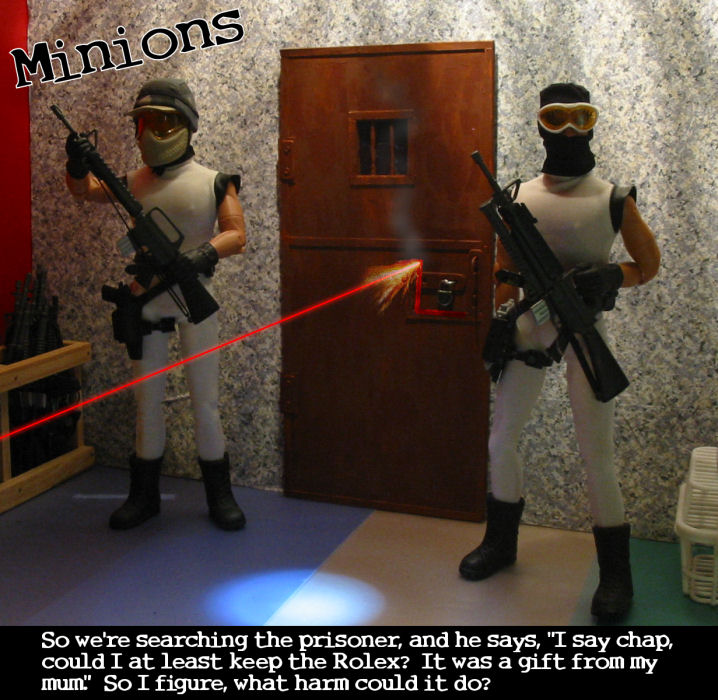
It's Monday, so there must be a new Minions cartoon posted over at Minions at Work. Check it out. Tell your friends.

Friday, May 26, 2006

Horrors! Oh, Horrors!

At the risk of starting a flame-war, I simply can't resist responding to this recent comment here:


Found this blog through a conan site (remember the Superman III incident) and after reading a little, I am shocked at how "industrialized" writing has become. I had no idea that there was this group of mercenary writers pumping out cookie cutter stories. Not because that's what they wanted but because it paid the bills.
Are we living in the light beer age of writing? Will technology soon allow a new age of liberated authors to write great books similar to the recent explosion in microbrews?


I never fail to be amazed at the surreal and romantic notions that people have about writers, publishing and "literature" (however you want to define that last term). Publishing is a business, and it's been "industrial" since the invention of movable type and/or the printing press.

I don't really know where the notion came from of the lonely, alcoholic writer starving for their art, chiseling their masterpieces word by painful word, stuffing the pages in a drawer for posterity.

Fact is, its very difficult to find a writer who doesn't at least aspire to "pay the bills" through their works, even if that means publishing in obscure literary magazines to support a academic career, or taking to the lecture circuit to speak to the legions of people who would like to pretend to have read your work.

That doesn't mean I'm saying all writers are in it for the money, including myself. Sure, there are some very, very rich writers (look at J.K. Rowling, for God's sake!), but in general, there are far easier and more certain ways to get rich. Heck, there are far easier and certain ways to become middle-class. If you want money, there are better ways to go about it, and I think every writer knows that.

Most professional writers write because they love to write, because they have to write. It's only logical that these people try turn their inescapable obsession into some kind of paying gig. Otherwise, you have to keep a dreaded "day-job," and it cuts into your writing time.

Sell more, sell better, write more, spend less time flipping burgers. It's a pretty simple formula that's worked for a very long time. If you love to write, you hope to sell.

Of course, though the author of the comment doesn't specifically say so, I suspect they're taking a pot-shot at "tie-in" writers, people who (like me) turn out books based on existing properties and universes, comic books, computer games, TV shows, movies, etc. Ah, well, anybody in this business is used to it. We're used to being dissed, even sometimes by our fellow writers. It was exactly that situation that lead to the recent formation of the International Association of Media Tie-in Writers, an organization created to promote and honor the writers engaged in this challenging and under-appreciated area of publishing.

Though I'm a member, I'll be honest that I don't know why it's necessary. Those of us in the business know the score, and I really don't care what the world-at-large thinks. My goal is to entertain my readers with the best book I can produce, and enjoy myself in the process. Most days I think I accomplish that. Not always, but most days. I'm content to let history sort our the literature.

Of course the implication of any such criticisms is that any tie-in book is inherently inferior in some way to any original work of literature, which is simply nonsense. Hacks don't last long in this business. And no matter how good you are as a writer, if you don't take your work seriously, if you can't put your best effort into it, then it's time to hang up your hat and call it a day.

Is one likely to find the pinnacle of 21st century literature shelved among the tie-in fiction? I doubt it, though it isn't impossible, and you'll certainly find a good number of fine and serious novels. For certain, you'll find a preponderance of enjoyable and entertaining books, many of which surpass their source material in every way.

Why do people think tie-in fiction is inferior? Well, first of all, there's the matter of its being based on existing material.

Perhaps the assumption is that the author is somehow limited or shackled by this preexisting structure. As if western literature and the novel form itself weren't a complex kind of structure to which the author is generally expected to conform. Writing with such strictures doesn't make things easy sometimes, but it's endlessly challenging and helps develop the author's skills. It can detract from the work, sure, but it can also be the annoying grain of sand that generates the perfect pearl.

As if many works of celebrated serious literature weren't derived from earlier literary works, historical figures, or characters of myth and legend. For instance, this year's winner of the Pulitzer Prize for literature, "March" by Geraldine Brooks is derived from the classic "Little Women," by Louisa May Alcott. In that respect (and admittedly, in that respect only), it differs from a Star Trek novel primarily in that it wasn't licensed or approved by the owner of the original work. Ms. Brooks just took a classic work in the public domain and used it as the springboard for her novel.

And it's even a broad generality to say that tie-in novels are automatically highly derivative. Most of my tie-in work, from Conan to MechWarrior has mainly used elements of concept and background. Virtually all the characters and their situations have been entirely original. Not all of it. The Star Trek and Generation -X books, for instance, have used mostly existing characters, but even then, many of the supporting characters are original to the work.

Then there's the matter that most tie-in fiction is produced under battlefield conditions. No waiting for the muse. No excuses (or none that your editor is likely to care about). No delivering a book radically different from the one you promised. It needs to be done. It needs to be done on deadline. It needs to be done to specification. It needs to fit the package we're prepared to market.

Does that hurt the quality of tie-in works? Sometimes, but less so than you'd think. Tie-in writers are, by definition, fast, and I could do a whole separate post (and I may, at some point) on the literary myth that fast means hackwork, and slow means quality. That isn't, in my experience, true at all. Sure, it's possible sometimes to push a novel too hard, to write it too fast, and that can hurt a book.

But in my experience, the natural pace of a book that's working well is pretty fast. When the book is moving slow, it's often a sign not of quality of care, but of a writer struggling with problems, or flailing around on a book they really don't understand yet. There are examples of great novels that took years or decades to produce, but I'll wager that if you could have been a fly on the wall, very little of that span was actually spent typing on the project at hand. Most was spent procrastinating, researching, throwing away false-starts, working on other projects, dealing with life, or flipping those infamous burgers.

Then there's the taint of writing "popular" fiction. Too many people like that Trek crap, so it can't be good. I'm convinced this is a legacy of the English class system. Anything attractive to the dirty masses is obviously not fit for the refined tastes of the literary upper-class.

This taint carries over to popular fiction as well, where its easy to turn one's nose up at bestsellers simply on the basis of their success. Yes, there's some pretty poor writing in the bestseller pockets at your local grocery store (though all of it is entertaining and successful on some profound level, of it would never be a bestseller). Yes, there are some books there written in a paint-by-numbers fashion that makes the most restrictive tie-in book pale by comparison. But there's also some damned fine stuff there on occasion.

If one defines literature as "works that will continue to be published, read, and appreciated long after the author is gone," (and admittedly, that's only one of many possible definitions), then I suspect that much of what will be read by future generations will filter through those best-seller lists, while other, more celebrated "literary" works fade into obscurity. It's easy to forget that Charles Dickens, for instance, was the Stephen King of his day, turning out commercial entertainments that were serialized in newspapers for the pleasure of the masses, or that "Moby Dick" was a huge bestseller, the "Da Vinci Code" of its day.

Oh, the hackwork. The bill-paying. The industry. The horror.


There's one other element to this comment that I'm going to address separately and less formally:


Are we living in the light beer age of writing? Will technology soon allow a new age of liberated authors to write great books similar to the recent explosion in microbrews?


The technology freely to self-publish via the internet has existed for over a decade. The technology to cheaply self-publish short-run print books via laser printers has existed since the 70s. I see no evidence that any of this has resulted in any flowering of literature. The creation of the blog may have made some kind of contribution to journalism and the field of non-fiction essays. But literature? The impact is virtually nil.

I think that's easy to explain. There's a misguided popular perception that the entire publishing industry and editorial process is a barrier that separates an vast and undiscovered trove of great books from their potential audiences. A single afternoon picking through the slush pile of any national publisher or magazine will quickly break you of that notion.

In fact, these institutions are a filtering mechanism, sifting through a sea of muck for the occasional fleck of literary gold, or at least somewhat impure silver.

Sure, some good stuff occasionally doesn't get published, or more rarely, a self-published book will be "discovered" and go on to major success through a conventional publisher. But I think these counter-examples say less about the industry, than about the failure of the authors to effectively and doggedly market their books. Good books are rejected every day for a zillion reasons, most of which have nothing to do with the quality of the book itself. But that doesn't mean that a good book isn't highly likely to sell somewhere with continued effort.

Technology isn't going to "save" us from the publishing industry. The publishing industry is saving us from people who only think they can write a book.

Tuesday, May 23, 2006

Kitten Picture of the day


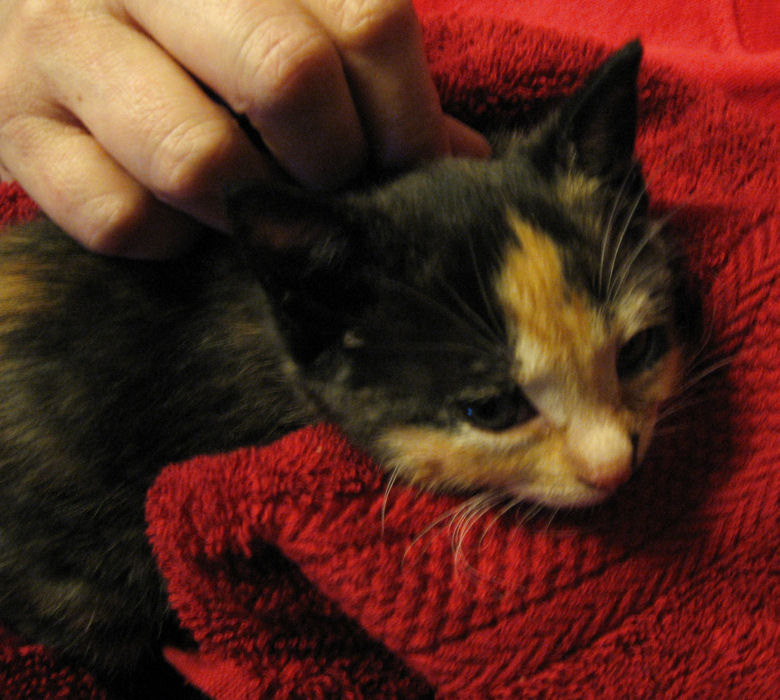
Awww, ain't she cute? Of course, if you look closely, you can see the little blood specks under my beard where she clocked me while tiring herself out playing.

Ah, but it's my fault. I let her rough-house on my chest and encouraged her to play. I expect to spill some blood in this stage of training a kitten. There are only a couple of commands I expect a cat of ours to know, and the most important one is "OW!"

Don't laugh, I'm serious. "OW!" means "whatever you're doing hurts, stop immediately." The way I taught Oz and Banzai this was just to play with them when they were young, but when they grabbed on too hard with claws or teeth, I'd freeze and shout "OW!" in such a way that they knew play time was over until they backed off. They pick it up pretty quickly, though it occasionally meant just sitting there with claws in my arm for a while. Let's face it, yanking your arm back is just going to make the situation worse anyway. Better to tough it out and teach the cat a lesson.

With Sydney, I usually also put my hand on her and just gently hold her down so she can't play any more. I could never get away with that with Oz (too big and strong by the time we had him) or Banzai (who was just too wild as a kitten). Sydney actually plays pretty gently, but those little claws and teeth are sharp, and sometimes she gets carried away. I think she's going to be a strong cat like Oz, so I need to get her trained early.

Oh, the the regular Monday Minions cartoon post is up at Minions at Work.

Saturday, May 20, 2006

A Girl with Attitude


Okay, this is not the sort of edgy in-your-face stuff that I sometimes strive for in this blog, but hey -- kitten pictures!

After the sad and premature loss of our #2 cat Banzai a few months ago, it's become increasingly obvious that we had to get a companion, or companions for our remaining cat Oz. He's bored, needy, and increasingly neurotic. The willful personality that had made him so amusing when teamed with Banzai was becoming intrusive and annoying.

Don't get me wrong, he's a wonderful cat, and no way we'd trade him for anything, but he needed company. A possible solution arrived when a pregnant stray cat showed up at the nearby home of our friends Dean Wesley Smith and Kristine Kathryn Rusch. Better yet, the stray showed characteristics marking her as likely being from the same family of strays that had produced Oz and several other wonderful cats previously adopted by Dean, Kris, and other friends.

The mother cat was feral, however, so catching her to have the babies in captivity proved to be out of the question. She threw herself at the bars on the carrier, and probably would have lost the kittens if they hadn't released her. So the hope was to wait until she had the kittens and they were old enough to wean, then catch her (for a trip to the vet to be fixed), and go track down the kittens for rescue and adoption.

We were willing to take a pair, and our friend Dan Duval was also willing to take a pair as companions for his lone cat. If there were more, we hoped to find homes for them as well.

As for how all this went, better to get the story from the source, as I wasn't one of the ones crawling under a house searching for hidden kittens. Serve it to say, there were only two surviving kittens, both girls. Dan got the quiet one. We got the feisty one.

We've named her "Sydney," after the lead character Sydney Bristow from "Alias" (Chris just having finished her second ALIAS novel, a character near and dear to us) because she was a girl who had attitude and could kick butt. You see, Sydney's default reaction to anything so far is to hiss, with option (but frequent) spitting. Swatting with the claws is also good.

Actually, despite her ongoing attitude thing, she's actually a very friendly little kitten, and has spent most of the afternoon and evening perched on one or the other of us sleeping, eating, and playing.


Since there were only two kittens to feed, both were rather large for their age. Sydney is the smaller of the two, but she's still large, and I suspect will be growing rapidly. They've very healthy, except that Sydney has a slight eye inflammation that should clear up with some salve the vet gave us.

Since the little girls weren't weaned, we're having to slip her over to solid food. Discovered very quickly that she loves beef baby food, as you can see from the photo. She ate probably two-thirds of the jar over a couple of hours. Hope to get her over to Science Diet kitten kibble in the next week.


The big hurdles now are getting her box-trained, and getting her and Oz to stop hissing and growling at each other. But the good news is that, despite being very jealous, Oz isn't being aggressive, and she isn't afraid of him (despite the fact that he weighs about ten times what she does). He hisses, and she just stares him down and hisses back. It will be interesting for the next couple weeks.

As for the box training, she's spending her nights and unsupervised times in a large kennel cage with a starter litter box. Hopefully we'll avoid any accidents until she figures it all out.

Yeah, that's what you came here to read about: litter boxes!

Friday, May 19, 2006

Minions on the Move (be sure to move with them)


The new Minions toon site, Minions at Work is live and running at:
http://minionsatwork.blogspot.com/

Monday's new panel will be posted there, not at the old Minions for Hire site. You'll also find all the exisiting Minions material reposted at the new site as well, so you don't even need to bookmark the old one as an archive (it will go away at some point anyhow). I will post a reminder of the new panel there, and every week for a while, until I'm sure all traffic has been directed to the new site.

Please bookmark the new link and delete the Minions for Hire link. Once again, I ask your help in passing the new Minions at Work link far and wide.

I apologize again to the Dandelion Studios folks for accidently treading on the title of their comic. You'll find a link to their site on the new page as well. My way of saying, "sorry, dudes."

And sorry to my readers out there for this inconvenience so soon after we've started. Just to make it worth your while to visit the new page, I've added a little "DVD Extra" feature for Minions #6.

Tuesday, May 16, 2006

Flying Cars Redux

The current issue of Popular Science magazine has yet another article on the flying car concept. As I said in my earlier post on the subject, this is one of those ideas that is as irresistible as it is impractical. According to the article, the Terrifugia Transition will have two seats, no luggage space, and sell for $150,000, "about the same as a fully-loaded Ford GT."

Uh-huh. I think I'd go with the Ford GT, or maybe a new Corvette to park at each end of my commute, and a boat-load of airline tickets. In either case, it will probably have just as much room, be more fun, and be cheaper to insure.

I just can't see the market for these. But then, when has that ever been the attraction?

Thursday, May 11, 2006

Cleaning out the news Junk Drawer

Mechwarrior Update

Confirmed today that the deadline for my untitled third MechWarrior Dark Age novel is being moved (for reasons totally unrelated to me) forward to early next year, rather than this summer as had originally be contracted.

This is fine with me, as (thanks to deadlines) I've hardly seen a spring or summer day in the last two years due to deadlines. The warm weather here on the Oregon coast doesn't last long enough that you can afford to waste it. I'm looking forward to puttering around the house (doing long-neglected repairs, improvements, and redecorating), and working on some original novels for a change.

Meanwhile, my second MechWarrior novel, Trial by Chaos, is still scheduled for release next month. I'll have some more to say about the background on this one when it starts to hit the shelves.


More Reasons Why Authors Don't Hand Out Free Books...


There is a strange expectation when people meet an author that the author has books to give them. It happens to me all the time. I'll meet someone in town, and it will come up in casual conversation that I'm an author. They'll say something like, "well I love to read. Bring me a copy and I'll read yours." Uh-huh.

Today a box arrived which finally contained the author copies for the first book in my "Anok, Heretic of Stygia" trilogy. This book has been out since last fall, and I had long ago gotten author's copies on books two and three of the trilogy. But somewhere the books for volume one were either lost in transit, or never sent, and once things got off the rails, it was hell getting them back on. I don't blame the nice folks at Ace books for this. These things happen, and in the great scheme of publishing, sending out author copies just isn't a huge priority. That's as it should be.

But in those months, I have given away a few copies of book one, to friends, relatives, contest prizes, and promotional copies. I bought all those copies at retail. And mind you, when I say that I got "author's copies," I don't mean cases of books. On this book, I got fifteen copies of each volume, and that's only because we negotiated the contract up from the boiler-plate figure of ten copies of each.

So, let's say that I put one copy on my "brag shelf." I keep another as a "beater" copy to haul around with me to show off. I call it a "beater," as it's likely to take some wear-and-tear in the process. I put away three or so copies for file and future use, and a put one as a shelf-copy in my office for reference. I send two or three copies out to immediate family, and give a few more to close friends. So that leaves me five or less copies for more casual friends, more distant family, promotional use, and whatever else comes along.

So if you meet a writer, don't automatically expect that they'll give you free books, no matter how much they like you, and if they do, be flattered. And if they do offer you a book from their own stocks, it would be polite to offer to pay for it, even if they don't ask, and to expect to pay full retail (since they may have to go buy a replacement copy at that price) and not some discounted amount. And if they give you a book, and won't take money for it, you should be flattered and properly appreciative. Perhaps they have a large stock of that title for some reason, but assume they're being especially nice to you.

Minions Update

You wouldn't know it from reading the Minions for Hire blog, where only a few comments have been posted, but I've been getting (via email and posts on other groups and lists) a lot of positive feedback on the Minions toons posted there so-far. Just as importantly, the stats show that people are following the link from Minions back to our main web-page, so the viral marketing aspects of this will work, as long as people actually visit the Minions blog in sufficient numbers.

Again, I ask your assistance in that. If you like the Minions, spread the link around to friends, family, or post it on mailing lists where you think it might be appropriate and appreciated (please don't go spamming on my account).

We're up to seven toons posted so far, and I have several more done and sitting on the hard-disk ready to post. My goal is to post a new one every Monday on an ongoing basis, and we'll see how it goes. I'm also thinking of setting up a Cafe Press store to sell Minions tee-shirts, mugs, and the like. I've got what I think are some very clever designs and slogans in mind for these items. I'll start work on this, once I get around to shooting some nice, posed group-shots of the Minions to work with. My goal is to produce shirts that will be funny even if you've never heard of the Minions before.

Thursday, April 27, 2006

Meet the Minions


I've just opened my latest attempt at viral marketing for beta-test. It's a blog devoted to photo-toons featuring the Minions, generic stooges of the type who populate every super-villain installation, from Goldfinger's estate, to Dr. Doom's castle, to the Death Star. You know the type: interchangeable. Expendable. Not too bright.

These are their stories, as dramatized by 1/6th scale action figures.

Minions for Hire

Okay, maybe it's less an attempt at viral marketing than an excuse to play with my collection of action figures, but you never know. Though I'm still filing off the rough edges, please feel free to pass the link along to anyone you think might enjoy Minions.

http://minions-for-hire.blogspot.com/

Tuesday, April 25, 2006

Farewell to a rocket man


I feel compelled to comment on the passing of former test pilot Scott Crossfield recently.

Though Crossfield was far less well known than some of his contemporaries, such as Chuck Yeager, his contributions to aviation and space flight were significant. He was the first person to break Mach 2, and one of twelve people ever to fly the amazing X-15 rocket plane.

Though not-much-remembered these days, the X-15 was one of the most exciting and significant programs in both aviation and space history. It was the first winged, reusable spacecraft (it flew many sub-orbital space flights), and by most measures, was also the fastest manned aircraft ever built. As a research aircraft, it pioneered many techniques and technologies still in use today.

But the X-15 program was a risky one. Crossfield cheated death in the X-15 at least twice. Once, when a rocket engine exploded in a ground test while Crossfield was sitting in the cockpit of the aircraft. And again when Crossfield's X-15 suffered an engine failure shortly after being dropped from it's B-52 mothership. The X-15 was designed to land with its tanks empty, and though Crossfield dumped fuel on the way down, the craft still touched down dangerously overweight. When the nose-wheel touched down, the X-15's back broke, nearly snapping it in half. Crossfield walked away, and the X-15 was salvaged, rebuilt, and flew again.

After retiring, Crossfield remained active in aviation and space, as an advisor, consultant, and industry executive. Though in his 80s, he continued to fly as a private pilot, and was killed when his plane crashed during a routine flight, possibly the victim of bad weather.

Some would say that Crossfield's amazing reserves of luck (and skill) had finally run, out, but perhaps not. Some people just weren't meant to die in bed.

I salute one of aviation's pioneers.

Thursday, March 30, 2006

Writers and other delusional people

UPDATED March 7, 2009 - Check at the end of the original post for new truths and comments.

I heard yet another story the other day of a writer being scammed by a so-called agent. What was most horrifying about the story was not that they were paying the agent to rewrite their stuff, but the sheer glee and delight with which the writer was submitting to the process.

Rule #1 in this business is: Money always flows towards the writer. If it doesn't, something is seriously wrong. If you fail to recognize this, or worse, mistake it for success, you are playing the fool.

There is no more gullible, self-delusional, fog-headed being on the planet than an aspiring writer. So predictable and common are their delusions that an entire industry of crooks, con-men and scam artists exists to exploit them, and such a sweet deal it is for them, too. Not only are most of their scams perfectly legal, their marks are actually grateful to be scammed! It doesn't get much better for a predator than that. It's like the entire herd of antelope crowding around the lion shouting, "Eat me! No, eat me!"

Wait. No. Keep reading. You may resemble this remark. Fact is, most of us do at one time or another. And if it does describe you, take comfort that you have plenty of company. I hear from these people all the time. Some of them I've had extended correspondence with, and I've learned some things.

Most of the writers getting scammed aren't dumb. They're nice, intelligent people who sincerely want to be writers, and have simply lost their way. Most of them are so invested in whatever flavor of Kool-aid they've swallowed that they not only can't see the truth, they don't want to. Yet most of them are aware, on some level, that something is wrong. That's usually why they write me. They have concerns. They have questions. Just not enough to wake up and look around. The correspondence, in antelope-terms, usually goes something like this: "This lion has actually agreed to take me on! Right now, it's chewing on my leg. And it's great! Although, I'm concerned about the bleeding. And the dismemberment. But really, it's good! It's great! Uh, should there be so much pain? But I'm good!"


Okay, here are the truths, some of them anyway, that every writer should know. Read them. Memorize them, Live them. And please, do so before you graze among the scam agents, book doctors, vanity publishers, and the various flavors of publishing delusionaries who, with the best of intentions, invite you to participate in their own mad delusions, and partake of their special Kool-aid.


Truth Numero Uno - Being Published vs. Being Read


First truth, and maybe even more important than rule #1 above (or at least as important): Writers do not need to be published. Writers need to be read. This should be obvious, but it's not. Having a pallet full of expensive hardcovers in your garage is not getting you read. Being in an ebook that's downloaded thirty times isn't getting you read. Going out through a small press or a literary zine with a print run of a hundred copies isn't getting you read (not in the way that you want to be, anyway).

Being read means selling to a national magazine, being published through a real book publisher and showing up on chain-store shelves, or at least being published on a high-traffic web-site with thousands of visitors daily. Yet again and again writers are seduced with the notion of seeing their manuscript in print between two covers. If this is you, my advice is this: Go to Kinkos and pick out a nice font, and some pretty paper. Then, once you have a book to look at, get over it and get back to the real work of getting read, or forget being a writer.

Corollary to Rule Numero Uno: The markets that will get you read most are generally also the markets that can afford to pay you the most money. Refer to Rule Number the Second.

Rule Number the Second - Payment

If you don't get paid, and I mean up-front, then it isn't a sale. People who don't have money to pay you generally don't have money because they aren't selling books. Refer back to Rule Numero Uno.

Corollary to Rule Number the Second: "Paid in copies" is an oxymoron.

Second corollary to Rule Number the Second: An advance is the only money you can ever count on, and even then, the check has to clear.

First Royalty Statement of Rule Number the Second: 6% of nothing is nothing.

Second Royalty Statement of Rule Number the Second: 100% of nothing is nothing.

Third Royalty Statement of Rule Number the Second: 110% of nothing is still nothing.

Rule Third, Third, Third - Editorial Opinions

Rule Third, Third, Third: Ultimately the only opinions about a manuscript that count are yours and the person who can actually buy the manuscript.

Rule Third, Third, Third Corollary One: Your mother cannot buy the manuscript.

Rule Third, Third, Third Corollary Two: Your workshop cannot buy the manuscript.

Rule Third, Third, Third Corollary Three: Your agent cannot buy the manuscript.

None of which means you can't listen to these other people, but the responsibility to apply (or not apply) their opinions is ultimately yours.

Scofield's Axiom (a superset of Rule Third, Third, Third): You are responsible for your own career.

Rule the Four - The Secret Handshake

Rule the Four: There is no secret handshake.

Rules 5 - Agents

Rule 5a: Any agent you can get as an unpublished, unsold writer is most likely not anybody you want as an agent. There are rare exceptions, but they are rare, and they are exceptions. Do not assume the agent courting you is either, until you have done much research.

Rule 5b: The primary job of an agent is to submit manuscripts and make deals. Agents do not sell manuscripts. Manuscripts sell themselves. If your manuscript is not equal to this task, the best agent in the world cannot help it.

Rule 5c: Anyone can call themselves an agent (just as anyone can call themselves a publisher). Saying it does not make it so. Neither does a business-card, letterhead, a web-site, or a line of snappy banter.

Rule 5d: Agents make their living off a percentage of the income stream of the writers they represent. Any deviation from this, either in terms of your own money or anyone else's, is at best highly suspect.

Rule 5e: Agents work for you, and not the other way around. That still doesn't mean you pay them, except as described in 5d.

Rules VI - Ideas

Rule VIa - Ideas are cheap. Ideas are plentiful. Stop thinking of them as being made of gold. A good writer can turn a bad idea into a good book far easier than a bad writer can turn a great idea into a good book. If you have only one great idea for a book, the best thing you can do is put it aside and think of a dozen more, because until you can do that, you probably aren't going anywhere as a writer.

Rule VIb - Nobody is going to steal your silly idea. Probably it isn't worth stealing, and if it is worth stealing, you probably aren't the first one to come up with it. In any case, so what if they do steal it? If you had an "idea for a house," and somebody else built it, would the house belong to you?

Rule VIc - Stealing words is a crime. Stealing ideas is frequently a smart thing to do, but always steal from the best. Start with Shakespeare and work your way forward.

Rule ala Seven - The Easy Genre

Rule ala Seven: There is no easy genre. Romance is not easy. Science fiction is not easy. Fantasy is not easy. Writing children's books is not only not easy, it is very, very hard. People looking for an "easy" genre don't want to write, they want to have written. They are pretenders. If you are the real deal, don't worry about what is easy, or what is hot. Write the stories you want to write, and the stories you want to tell. Practice. Develop your skills. You can worry about marketing later.

Rules da 8 - How Becoming Published Will Change Your Life

Rule da 8: When you make your first sale, your problems are only beginning.

Rule da 8.1: Publishers don't buy books, they buy careers. If you aren't thinking past your first book, you are of very little value to anyone. Pray the publisher forgets to ask.

Rule da 8.2: Wash, rinse, repeat. Repeating is the hard part.

Rule da 8.3: The only time a second book can be easier than the first book is when the second book is already written, and even there lie pitfalls.

Rule da 8.4: You can't rest on your laurels unless you have some, and even then, laurels don't pay the electric bill.

Rule da 8.5: Sharks gotta swim, writers gotta write. Sharks stop swimming, they die. What does this tell you about writers?

Statement of Limitation

Those are only a few of the truths that aspiring writers need to know, but they're enough for you to chew on for a while. Pretty much, success in this business boils down to do the work, submit the work, and keep learning. Don't waste your time looking for shortcuts, because none of them preclude these three basics and the search will waste your time.

And remember that you don't even have the right to call yourself a failure if you don't try, and you still don't have the right unless you've stopped trying. Until then, you're still a success waiting to happen.

Good luck out there. Just remember, you make your own luck.

UPDATE March 7, 2009 - YET MORE TRUTH
Here we are a couple years later, and I find myself revisiting this post, and lo, among the comments below (you can dig though yourself to find the context, though it isn't especially important), I made the following statement:

"I have a great agent that I'm very happy with."

Looking back at that, I added the following comment, and having done that, I decided it was important enough to move up here where people can more easily find it. Here is a slightly reedited version:

-------------

Interesting reading my comment above. See, my the Great Agent I mentioned is now somebody else's great agent.

Actually, they were somebody else's great agent while they working for me too. Turns out they weren't MY great agent.

So allow me to add:

RULES OF AGENTS

RULE OF AGENTS NUMBER THE FIRST
No great agent is a great agent unless they're great for YOU. It doesn't matter how good an agent they are for someone else. If you're going to work together, you have to be compatible in your goals and methods and they must be helping your career. It's a relationship. There are no absolutes.

RULE OF AGENTS #B
Ask not what you can do for your agent. Ask what has your agent done for you lately.

RULE OF AGENTS No. III
Despite what they'd like you to think, you don't need your agent nearly as much as your agent needs you. (And if you DID need them more than they need you, why should you trust them to serve your best interests, and not their own?)

RULE OF AGENTS Nbr. Fore
Should you discover your great agent is not great for you (or perhaps not great at all) apply SCOFIELD'S AXIOM (see the previous rules list) until the problem goes away. Not having an agent is an infinitely better situation than having an agent that isn't working for you.

-----------

Okay, let us return to the statement that started this:
"I have a great agent that I'm very happy with."

Let us add to the original list:
-----------

RULE NEIN - THE BELIEF RULE
Just because the writer believes something is true, does not make it so. The writer's capacity for self-delusion is boundless, endless, and sneaky as hell. None of us is immune.

Ever.

------------

Not even me.

And just so you don't think this is just sour grapes aimed at my former agent, it isn't. They really are someone's great agent, from what I can see. They might be yours.

Or not.

But when you're signed with an agent and things are perking along, it's easy to ignore the problems until you've done yourself considerable damage, and that's what happen to me. I let my agent's opinions undermine my self-confidence, and I sat on plenty of perfectly good novel projects until I let my career stall. (See "Rule Third, Third, Third - Editorial Opinions" above.)

I'm not saying my agent did it to me. I did it to myself, by hanging on with an agent whose methods and goals were not my own, and whose focus was (properly, from the agent's perspective) on bigger fish, and not the careers of smaller players like me.

I sat around for far, far too long fretting in the dark, before contacting my agent with hard questions, confronting the situation, and making the break.

Self delusion.

Why do writers do it?


As it happens, I'm currently reading an interesting book titled "Lonely Planets, the Natural Philosophy of Alien Life," by David Grinspoon (apparently out of print, but you can still buy it on Kindle) and yesterday I ran across these words:

"So strong is our desire for certainty in the face of this grand mystery that we cannot resist the urge to vastly overinterpret every bit of potential evidence." and "We find signals in the noise of existence and read into them the conclusions that we want to reach."

Grinspoon is talking about our (the big humanity "our") questions regarding the potential for intelligent life in the universe, but it applies perfectly to writers as well.

It's our nature. We're all sitting alone, looking out into the darkness, pulling patterns out of nothing, weaving stories out of dreams. It's hard to turn that off when we need to put on our business hats. Maybe it's impossible.

But we still have to keep trying.

Me too.

Good luck to us all.

Saturday, March 11, 2006

Snow Day


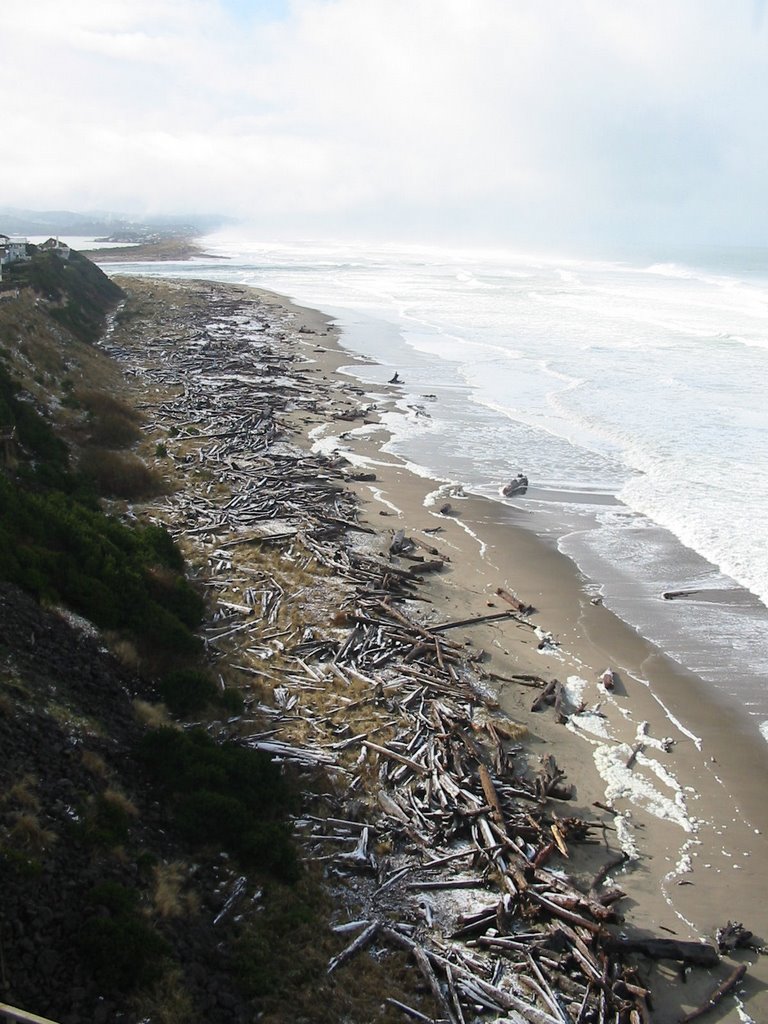
We've been getting some of the freakish early-spring weather that we sometimes get here on the Oregon coast. We woke this morning to find several inches of snow on the ground. Those of you in the east or Midwest or similar places are laughing at that, but snow is a fairly rare occurrence here, and always noteworthy.

I'm not unused to snow. We didn't see huge lots of it when we lived over in Eugene, but it was typical to see it a few times a year, often in some quantity, and often it would stick around for at least a few days.

Not on the coast, even though we're only a little over a hundred miles away. The ocean moderates our weather: almost never too hot, rarely too cold. When snow happens, it almost always melts within a few hours, a day or so at most.

But snow on the beach is a kind of magical thing to me, much more so than snow inland. It looks so stark and dramatic on the sand, and it's surreal to watch the waves rolling in and out, capped with floating drifts of snow.

The picture above was taken from my wife, Chris' office (at her 9-5 job), looking south along the beach. The white you're seeing isn't foam, it's snow. The scale is always deceptive from up there too. Those aren't sticks you're looking at, they're logs, some of them old-growth trees that weigh as much as a loaded semi-truck. If you enlarge the picture (click on it) and follow the bluffs up to where the inlet is, you'll see a couple fair-sized houses on top of the bluff there. That's your only real clue to scale here. This picture covers a lot of territory.


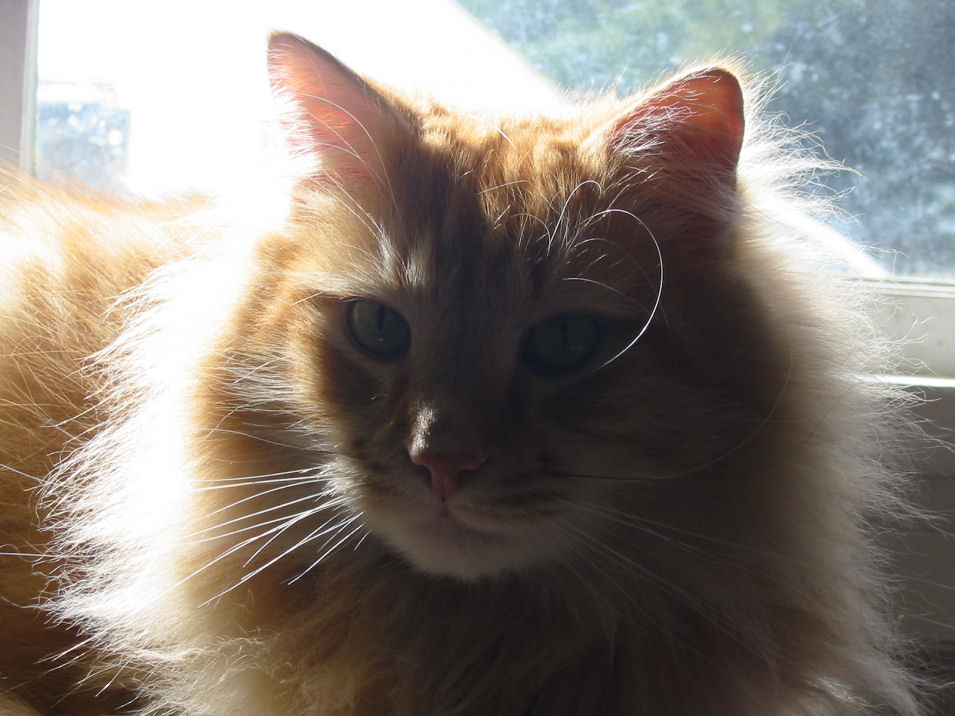
One other nice thing about days like this is the unique quality of the light. Our remaining cat, Oz perched in the sun-lit front window this morning curiously watching the snow fall. That's when I snapped this last shot. The cat does take a good picture, doesn't he?

Tuesday, March 07, 2006

Flying cars and other bad ideas


I've always been fascinated by the intersection of technology and human culture, and I studied it rather intensely during my time working in the computer press and the computer industry itself.

It's made me, among other things, a terrible curmudgeon about product interface design and usability. (My conclusion: either I know more about it than the combined resources of most technology companies, or most companies just don't care, probably the latter.)

It's been my intention, since starting this blog, to touch on this subject area occasionally, and I thought of it today when, on a newsgroup I frequent, the old subject of flying cars came up again. Specially, the subject was this typical example of the breed, the terrific, seen above. Another current example is the Moller Skycar, which has been bouncing around (and occasionally sorta-flying) for many years now. The Skycar is always just this close to becoming operational and changing the world. I predict it will remain this close for a long time to come.

Really, as fanciful as these vehicles may seem, getting a car to fly (or a plane to drive like a car) isn't that hard, nor is it new or futuristic. Glenn Curtis made the first attempt to build one way back in 1917. It wasn't successful, but people kept trying over and over, often with fair technical success. The first flying car to be certified by the government was the Airphibian, almost 60 years ago. It could drive at 50mph, and fly at 120mph. If flying cars were ever going to succeed, it was going to be in post-war America. Financing couldn't be found, and the Airphibian was lost to history.

Yet a series of ongoing attempts were made to create and market flying cars, and they continue even today. I have three words about this: "forget about it."

Flying cars fall into a special and interesting class of ideas: wardrobe ideas that nobody really wants. This class of ideas are something like technological tar-pits, irresistiblly attractive ideas that draw in inventors, dreamers, and occasionally backers, leading to their inevitable waste. And no sooner has the last victim slipped beneath its shiny surface, when another shows up to take their place.

Now don't get me wrong. I love flying cars. They're fun to look at, and fun to think about. But I don't want one, and most likely, neither do you.

Lets take a closer look.

The attraction of flying cars is obvious. Who hasn't sat stuck in traffic, and dreamed of push a button on the dash that allows them float effortlessly into the open sky, and leave it all behind?

Actually, that's where the fallacy starts. This works very well in the comic books, or in movies like Bladerunner, Back to the Future, and The Nutty Professor, but none of the operational flying cars have ever offered that possibility. If it could be made to work, the Moller Skycar might offer something close, but that's a very big if in this case.

In fact, most "flying cars" need to take off and land at a conventional airport just like any other plane. Upon landing, they transform (often with considerable manual help from the pilot and passengers) by folding, shedding, or towing their wings and other airplane-specific parts, at which point the pilot is left to drive his now-grounded vehicle through the bumper-to-bumper traffic with the rest of us. In this day-and-age, with small airports being turned into Home Depots and housing developments at an unprecedented rate, your ground-bound commute could be long indeed.

This is one of several reasons I maintain that there was a limited window for flying cars to be adopted after WWII. This was a golden moment in history. There you had the prosperity to buy them, the industrial capacity and skills to build them, a huge pool of skilled ex-military pilots to fly them, many small airports to fly them from, new housing developments springing up everywhere, any of which could have been designed to add a small landing strip for flying cars. Also important, it was before the era of auto-safety regulations. Making a car fly is fairly easy. Making a car meeting all current crash-safety standards fly is near impossible.

But it didn't happen, and that time is gone. Even if you have a flying car, the odds are good you have no place to take it off near your home, and no place to land it near your destination.

As I said, making a flying car meet safety standards is a problem, but the fact is, a flying car is just a nest of unhappy compromises. The qualities that make a good airplane do not lend themselves to being a good car, The qualities that make a good car do not lend themselves to being a good airplane. The result is usually a slow, heavy, inefficient, difficult-to-fly airplane that turns into a slow, small, cumbersome, horribly expensive, poor-driving automobile, often at a cost that exceeds the combined cost of buying both a separate plane and car.

Ultimately there are no advantages over taking a cheap commercial airline seat between those two airports, and renting a car (cheap, universal, reliable car-rentals are another thing that didn't exist in that post-war era). Even if you still want to fly your own plane, you can still get that rental car, and the different in cost between a good used light-aircraft and a new flying car will buy you decades of car rentals.

Of course, there's the expectation that technology will come and solve all the problems. But to quote Scotty, "you can'na change the laws of physics!" Any aircraft compact enough to fly from your driveway will almost certainly be too loud to operate in a residential area. The lift simply has to come from somewhere, and since a running start with wings or big rotor-blades are out of the question, you need jets, or rockets, or small fans or blowers. It's going to sound like a truck-load of chain-saws battling a truck-load of leaf-blowers to the death, no matter how you do it.

The Family of Bad Ideas

Flying cars are, by and large, useless. Build it, and they will not come.

There are many other ideas in this same family. Take for example the video phone. This one has been around in prototype form since at least the 60s, and it always sounded cool, but nobody really wants it for everyday use. At some point, every day is a bad-hair day, and we all know that's exactly when our boss or our future mother-in-law will call. Video phones suck.

The technology for internet videophones, of course, is there for anyone who wants to buy it, and it has niche applications, teleconferencing, phone sex, visiting the grand-kids. But for the most part, this just isn't going to take-off unless our society does, and in a big way.

Curiously, though nobody wants video-phones, people do want camera phones, and even phones with video, in a big way. These are different of course, in that standard phone conversations are the default, and pictures a special function. As these become more common, perhaps they will reshape us into a society where people think nothing of seeing half-dressed perfect strangers before their first cup of coffee in the morning. Hopefully I won't live that long.

Another related idea that at least had the decency to lay down and die was the touch-screen computer. The idea was simple and obvious: we were all going to operate our computers by punching pixel-buttons, and dragging things around on the screen using our fingertips.

It sounded great. It sounded simple. It sounded natural. It sounded easy.

This one actually got to production, with Hewlett Packard (people who should have known better) building a line of touch-screen equipped desktop computers. That's when people discovered it wasn't such a great idea. The screen clouded up with fingerprints, people's hands got in the way of what they wanted to see, people's arms got tired, and the human finger turned out to be just too blunt and inexact an instrument for many tasks. Then there was the matter of a little thing called the Mouse, which did the same thing, only better, cheaper, and easier. It took maybe five minutes longer to learn, which pretty much every person in America did a long, long time ago.

Touch screens still survive, like the video-phone, in niche applications: palmtop devices, service kiosks, bank machines, credit-card terminals, and even a few computers. And I have no doubt that the practical merging of display and input device will come along eventually, perhaps even fairly soon. But the desktop computer controlled primarily by tapping on its screen, that was an idea whose time never came, and likely never will.

Bad Ideas that Aren't


I'd like to discuss one last idea near-and-dear to me, one that many other people would say belongs to this category of ideas: the ebook. I beg to disagree.

There have been many efforts to commercialize and market ebooks, with small success. I've written several ebooks myself, our entries into the Star Trek SCE line. In fact the first of these made the top ten of the national ebook best-seller list, putting us up with folks like Grisham and King. But because it was an ebook list, it meant we had sold only hundreds of books at most, and that even names like King and Grisham couldn't do any better.

Sales of ebooks have continued to grow steadily since then, but the numbers are still tiny compared to print books, and many book-lovers are quick to pronounce from this that ebooks will never succeed. They inevitably start ticking off a list of advantages of print books, starting with their lack of need for batteries, and very often ending with their smell.

Yet I maintain that ebooks cannot be placed in the family of the flying car and the video phone. In fact, print books are something like the flip-side of a flying car idea. They're the thing you're already using that you think you love, but you really don't. No child who has ever gone through a school day hunched over under the weight of a massive backpack can really love print books.

They're too heavy, too fragile, too hard to store, too difficult to keep open to the right page, too difficult to search, too hard to organize, too difficult on our aging baby-boomer eyes. We don't love books, we love what's in books. Yes, there are esthetic aspects that will always happily remind some of us of pleasant reading experiences, the book is not the content, and the content is not the book. The only thing "saving" books is that there hasn't been a better alternative until now, and if you look at the losses publishing has suffered against other media such as television and video games, you could argue that they haven't been saved at all.

The practical ebook still isn't quite here yet, though I have little doubt it will be. The main technical issues remaining are screen readability, cost, and battery life. Those problems will likely be solved soon, and most likely, all the necessary parts will be incorporated into some electronic device not sold as an ebook, perhaps a phone, or some consumer device that incorporates a phone along with many other functions.

At the very moment those devices are out there, and the screens are at least as good as a paperback book (a pretty low target, actually, I expect they'll surpass that very quickly), and the batteries last as long as a current phone or iPod, then ebooks will take off.

If the industry is in place on that day in a sensible way, with good selection, ease of purchasing, reasonable copy protection, and fair prices, then they'll buy books. If not, they'll steal books, just as people steal songs and videos now. I pray the business is ready, but the track record for such transitions isn't good.

For some ideas, their day will never come.

For others, their day just isn't here yet.

judgment day is coming.

Sunday, March 05, 2006

Boldly Searching...


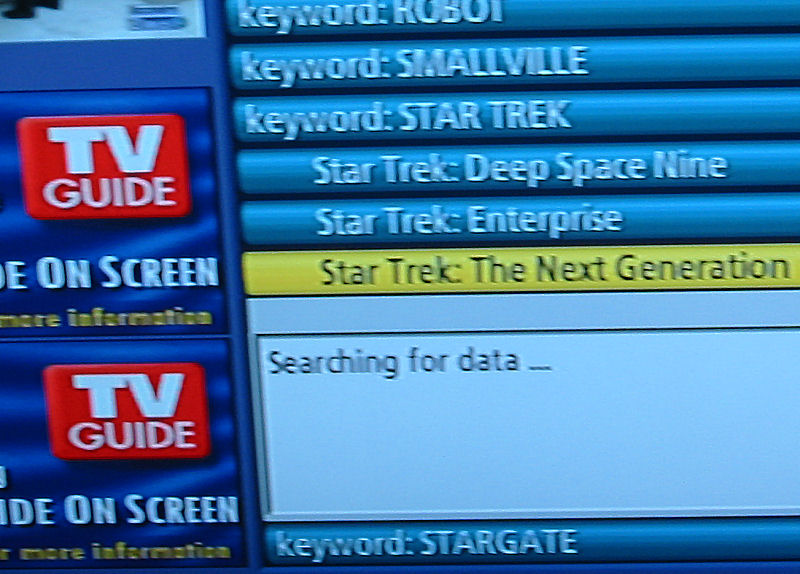
Preparing to research our (hopefully) upcoming Star Trek project tonight, I decided to fire up the digital video recorder and look through the upcoming airings of Star Trek episodes, figuring there might be some potential sources of information, or at least inspiration, that we should record and watch. As I was going through the on-screen program guide's function, this screen appeared, and I fortunately had the camera handy. From there I think it pretty well explains itself...

By the way, on a related note, according to an item appearing in the February 11-17th issue of New Scientist, the praise "to boldly go where no man has gone before," is almost definitely derived from the text of a widely distributed 1958 White House pamphlet called "Introduction to Outer Space." The pamphlet version is, "to try to go where no one has gone before." "Boldly" is a nice improvement, but somehow the more sexist "no man" got introduced with it, and it wasn't changed back until Star Trek the Next Generation made the air. The link included in the article isn't working for me, but you can find the relevant original text of the document here.

Friday, March 03, 2006

Still out here


It's been a while since I posted, in part because there hasn't been a lot to report, but also just because I've been throwing myself into other distractions since we lost Banzai. I kept looking at the blog though, and thinking what a depressing note that was to leave things out. "Hey, everybody! Come on over to Steve's blog and get bummed-out! It's fun!"

So here I am today, with still not a huge lot to report. I'm still waiting on information from Wiz Kids so I can start outlining my next MechWarrior Dark Age book. My upcoming MechWarrior books, Trial by Chaos should be out in June. Chris' Alias book, Strategic Reserve should be in stores most any time now.

We did also just get invited to work on another Star Trek ebook project, similar to our previous Star Trek SCE work in format, but a different line. It may be premature to talk about that though, so I'll just tease for the moment.

Still missing Banzai sometimes, but I'm feeling better. His run was short, but good. He's buried in the corner of the front yard. Right now, there are just some old bricks on top of his grave, but the other day I had an inspiration. Why not take it and turn it into something fun? I'm giving serious though to getting some bags of dirt and a pile of paver bricks and building a miniature "lost tomb of Banzai" as a garden feature. It would be a little GI Joe sized ruin peeking out of a mound of earth, with cat statues on the steps, and perhaps some other "in-jokes" for Banzai.

Strange? Macabre? Maybe, but Banzai was a fun-loving and kind of theatrical cat, so I think he'd appreciate it. Besides, it will give future generations something to puzzle over.

Monday, February 06, 2006

He was a good cat


It was a very sad weekend here. Our cat Banzai passed away early Sunday morning after a long illness.

Just before Christmas he stopped eating on his own, and steadily became thinner and weaker. The vet diagnosed him with liver problems, and we put him through a series of antibiotics and drugs designed to stimulate his appetite.

Nothing worked. He fought the medication, and we had to feed him by baby bottle (much to his annoyance) every day for those last six weeks. Fortunately, he never seemed to suffer. He enjoyed being petting and brushed right up to the last day, and wasn't reclusive at the end as many cats are. He died peacefully at home, with us there at the end. That's not much but it's something.

They say cats have nine lives, and Banzai has probably been through several of them since we've had him.

I found him on our door-sill in December just over three years ago. It was night, the middle of a raging storm. The wind was blowing 40-50 mph, and our screen door had broken loose and was slamming open and closed right next to him, hard enough to kill him if it hit him. He was just a kitten, abandoned by mom, or dumped, I don't know. We'd seen him around yard in the couple of weeks before, and assumed he belonged to a neighbor and that his mom was somewhere near, but that apparently wasn't the case. Apparently he had been living in our crawl-space, where a repairman had spotted him a few days before.

I was home alone, watching TV, when I heard head his cries from outside, barely audible over the howling of the wind. At first I thought I imagined it, but I went and carefully opened the door, and he walked inside.

The problem was, I didn't see how I could keep him, or even allow him in the house. We had just adopted a new cat (another rescue from across town), and only a few months earlier we'd lost another cat, "the Dude" to Feline leukemia. She'd (yes, "the Dude" was a she, long story). She also had been a neighborhood rescue, and unknown to us, had been sick when we adopted her, so we knew that the disease was out there, and had just been through the pain of watching her die. I couldn't bear risking Oz if he was sick, and at this point, Oz hadn't been tested either, so it was even possible he could give it to the new kitten.

So, with nothing else to do, I took the kitten back to the back of the house and put him in the crawlspace, where I knew he'd been before, and where he'd be safe from the storm. I had barely walked back to the front of the house when I heard him outside again! He'd run completely around the house and had beat me to the door!

At that point, I had to do something. He was going to die, from exposure or that loose door if I didn't do anything quick. I finally relented, and put him in our sun-porch, which was unheated, but at least dry and tried to make him safe and comfortable. The next day I went door to door looking for his owners, but while many people had seen him around, nobody claimed him. Both cats went to the vet (separately) for testing and shots, and when they were both pronounced healthy, Banzai came into our life for the duration, short though it turned out to be.

"Healthy" was always a relative term with Banzai. I know he was malnourished as a kitten, and I suspect his mother was as well. He was clumsy, had poor circulation in his back legs, and seemed to have no "full" switch when it came to food. We called him "the belly that walks," and his long, silky, hair only made him look bigger.

He was a happy little Buddha of a cat, playful, loving, and always getting into some kind of trouble. He and Oz were like brothers: playmates, friends, and rivals all at once. They'd wrestle constantly, steal each other's food dishes, and argue without really fighting (most times!). Oz would groom Banzai, and it would inevitably lead to a wrestling match at some point. Their personalities couldn't have been more different, but they complimented each-other perfectly. They were a great team.

This wasn't his first serious illness either. He had another bout of the same thing about a year ago (mistaken by another vet) and when we'd written him off as dead, rallied and made a full recovery. It gave us hope that he'd do it again, but that wasn't to be.

They say cat's have nine lives, and maybe Banzai used up a bunch of his before he showed up on our doorstep. That certainly seems possible.

But I have another theory about cats. Maybe they have a fixed allocation of stories, and Banzai used his up at an astounding rate. There was the time he got locked in the pantry over-night, and happily ate a tunnel through an unopened 25 pound bag of Science Diet cat food. I came into the kitchen the next morning to see a fan of cat-food spreading out under the pantry door. I opened it, and Banzai happily waddled out as though it had been the best night he'd ever had.

There was the time he got hold of a ball of yarn and proceeded to weave it into a 3D sculpture that stretched from one end of our house to another and across both floors.

There was the time his fixation with yarn lead him to climb under the eaves of the attic, find sealed boxes of the stuff, and rip holes in the side so he could spread it all over Chris' office.

There were the many times he raided Chris' lingerie drawers (he loved those soft and frilly things, go figure) and left various garments in interesting places. We jokingly called him the "cross-dressing kitty."

There was his (possibly related) obsession with pink feathers and fur (they say cats care color-blind, but this cat could definitely tell pink when he saw it). He once plotted for days to steal a teddy bear with a pink boa from a high shelf, and he loved to steal Chris' joke "romance writer pen," a pink ball-point with feathers on top. We finally just learned that anything with pink fur or feathers was either locked in a cabinet, or it was a cat toy.

There was the way he climbed down the cat-ladder in the picture. It's 8 feet tall, and connects Chris' attic office with my office down in the converted garage. Never graceful, Banzai would reach down, hook his front claws, and then swing his butt down to the next platform like a climbing monkey. He couldn't jump very well, but if he could hook his claws in, he could climb paw-over-paw like nobody's business, and he was completely without fear.

He was always skittish and jumpy (probably because of the trauma of the storm), but he quickly warmed to house-guests, and never knew anyone who wasn't a friend. Many an over-night guest would wake up to find Banzai sleeping on them. He liked to sleep on my chest when he could, or he'd come up and perch on my arm when I was sleeping on my side. I had a recurring dream that I was Snoopy's dog-house!

He also loved to sit on heating registers when the furnace was on, and late at night you could hear him plop down and seal off the duct in our bedroom like a cork in a bottle. We could freeze, but Banzai would be toasty.

Banzai was an inside cat, and would never go near an open door again, but our other cat, Oz is an escape artist. Several times he's gotten out and vanished over-night. But every time it happened, even for a few minutes, Banzai would punish him for it. For days, Oz was no longer the Alpha kitty. Normally easy-going Banzai would growl at him, swat him, and steal his food, so that Oz would know he'd done a bad thing. Oz never learned, of course, but Banzai never gave up trying.

Now everywhere I look in the house, every thing I look at, it seems like there's a Banzai story to go with it, some funny anecdote, some funny sound he used to make, some funny thing he used to do. Even while were we were morning him Saturday night he was making Chris and I laugh through our tears as we shared our memories.

Our friends (and fellow writers) Dean Wesley Smith and Kristine Kathryn Rusch came over at 3AM to comfort us and help us bury Banzai. You simply can't get better friends than that.

Banzai is in the front yard now, under some bricks by the front fence, where Oz I and I can see him from my office window, and just maybe he can keep an eye on us.

I'm going to miss him terribly. For a guy who writes war, barbarians, death and destruction, I'm a terrible softy for animals. They become very important in my life, and it hurts me deeply when they're finally gone.

But I remember them. They tell me their stories, and I write them down.

Goodbye Banzai. You were a good cat. You still are.